The Mid-Corner Mystery: How Max Verstappen’s Unreplicable Technique is Terrifying Formula 1 Engineers
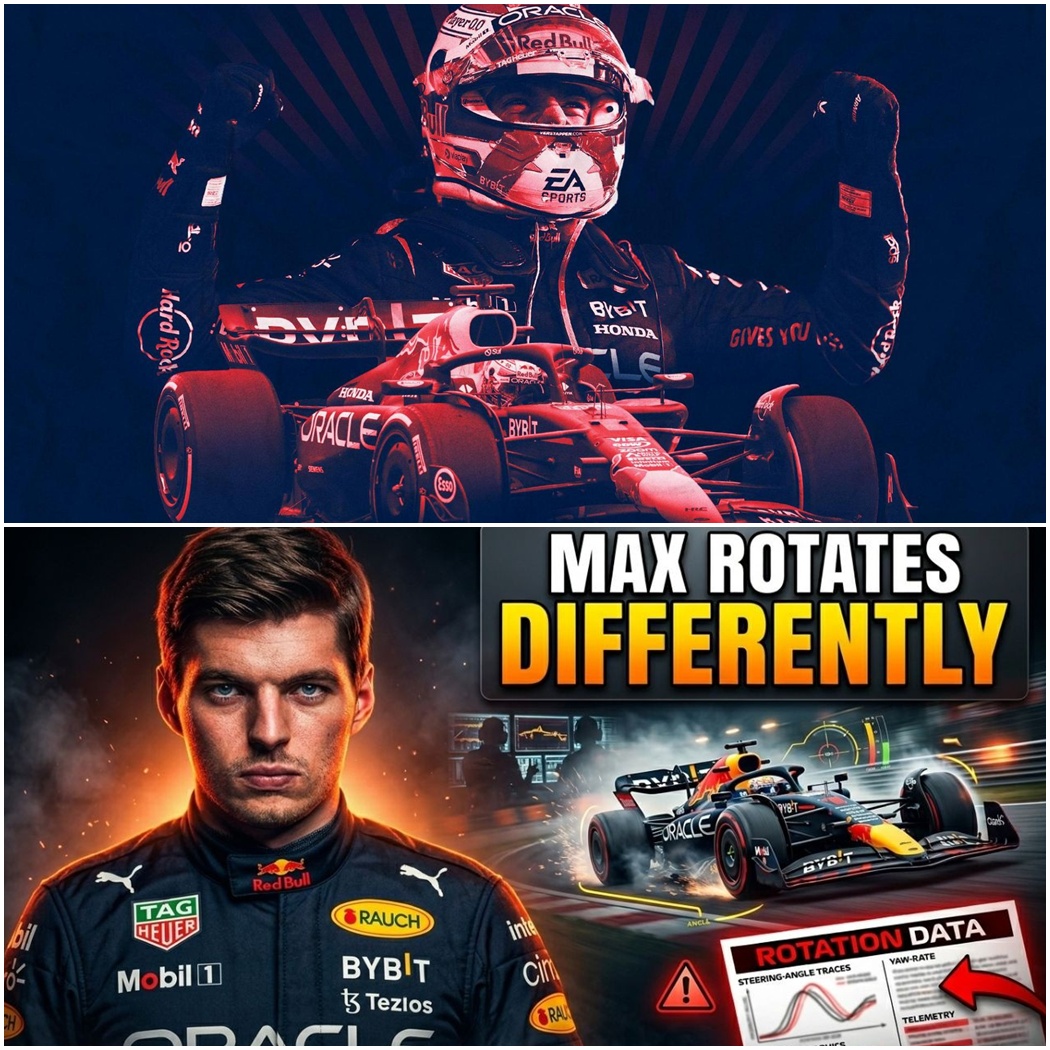
There is a fleeting, almost imperceptible moment in every single Formula 1 corner. It is a fraction of a second that remains largely invisible to television cameras and impossible to truly comprehend unless you are the one strapped tightly inside the carbon fibre cockpit. It is the exact moment where the racing car either violently commits to the turn or briefly hesitates, where the driver either finds the necessary rotation or is forced to wait for it. For the last four years, Max Verstappen has been doing something deep inside that specific window of time that is starting to genuinely frighten the brilliant engineers trying to defeat him.
The fear does not stem from the Red Bull chassis, nor does it come from the Pirelli tyres. The fear is entirely directed at him. Rival engineers possess mountains of data. They have the capability to pull up every single lap Verstappen has ever driven and meticulously compare it to the telemetry of every lap his teammates have driven in the exact same machinery, on the exact same day, and on the exact same tyre compounds. Yet, what they consistently see hidden within those digital traces—what they have been obsessively studying for years and what rival teams have built entire, multimillion-pound simulation programmes trying to replicate—is something that completely lacks a clean, logical technical explanation. It is a level of mid-corner rotation control that is so breathtakingly precise, so unbelievably consistent, and so far beyond what any other driver on the grid can physically produce, that the very people whose job it is to understand it are still not entirely sure how he manages to do it.
To understand this phenomenon, we must step away from the laboratory and look directly at the anatomy of a corner. Every racing corner is fundamentally divided into three distinct phases. First is the braking zone, where the car violently sheds speed. Second is the apex, the innermost point where the car is closest to the kerb. Finally, there is the exit, where the driver applies the throttle to accelerate back down the subsequent straight. The lap time you either gain or lose is a culmination of all three phases. However, the one phase that definitively separates multi-time world champions from the rest of the pack—the specific area where the brightest engineering minds in Formula 1 spend the majority of their time obsessing—is the apex. More precisely, it is what happens to the car’s dynamic balance at that apex: whether it rotates, how violently it rotates, and whether that sudden rotation can be caught, controlled, and converted into earlier throttle application on the way out.
The vast majority of professional racing drivers approach rotation as a natural consequence of their mechanical setup. They sit down in technical debriefs and ask their engineers to build a car that rotates in a predictable manner. They then drive around the car’s inherent characteristics, working politely with what they have beneath them, trying to make the absolute best of the situation. This is perfectly normal. This is exactly what ninety-nine per cent of racing drivers have done for their entire careers. You ask the car to do something, and you adapt your driving style to help the machine comply. Verstappen, however, does the exact opposite. And in doing so, he is completely breaking the traditional model.
Alex Albon famously raced alongside Verstappen at Red Bull for a year and a half. Albon is by no means a slow driver; his subsequent stint at Williams proved him to be one of the grid’s most reliable and consistent point scorers. He is a top-tier professional who deeply understands the extreme technical demands of the sport. Yet, when he once sat down to explain what it was truly like to drive the same car as Verstappen, he reached for an analogy that has since become legendary inside the paddock. Albon explained that Verstappen’s preferred setup—the terrifying level of front-end sharpness he demands from the car—is exactly like playing a computer game with the mouse sensitivity turned all the way up to its absolute maximum limit. One tiny millimetre of physical movement, and the cursor violently shoots across the screen.
That is exactly how the Red Bull feels when Verstappen dictates the setup. Albon noted that this level of sharpness is not simply impressive or challenging; he used the word “eye-watering.” That is how a former Red Bull driver described the visceral sensation of getting behind the wheel of Verstappen’s machine. Albon added that as the car becomes sharper and sharper, a normal driver begins to physically tense up. You lose pure confidence in the machinery. It simply does not work for mere mortals. It never works. But the million-dollar question that remains unanswered in the paddock is: why does it work so flawlessly for Max Verstappen?
Red Bull Team Principal Christian Horner has previously addressed this enigma. He noted that Verstappen is incredibly specific about what he requires from a car, which is invariably a very positive, heavily planted front end that turns in sharply. Horner then acknowledged a technical reality that should make every rival engineer deeply uncomfortable. He admitted that the natural consequence of aggressively sharpening the front end is that it severely unsettles the rear of the car. For almost any normal driver, a loose rear end is tremendously confidence-sapping. Yet, Horner stated that this is exactly where Verstappen excels. This is where he is uniquely able to live on the razor’s edge of adhesion.
Living on the edge of adhesion is a poetic way of describing a terrifying physical reality. Most drivers carefully search for the limit of grip and then instinctively back away from it slightly, knowing that crossing that line results in a catastrophic spin. Verstappen, conversely, finds that exact limit and comfortably sets up camp right on top of it. He does not back away. He stays residing there, corner after corner, lap after agonizing lap, operating at speeds that would undoubtedly send any other driver hurtling into the barrier.
When a Formula 1 car enters a corner with an ultra-aggressive front-end setup, the nose bites into the apex with maximum force. This pulls the front of the car violently toward the inside kerb. Simultaneously, the rear of the car—because the setup has been deliberately sharpened beyond normal human tolerance—begins to step out. The rear becomes loose, light, and desperately wants to swing wide. In that fraction of a second, the car is in a state of wild, controlled rotation. Every engineer desperately wants their driver to generate this apex rotation because it means the car is pointed toward the exit straight much earlier. But a car in this state is fundamentally dangerous. The rear stepping out means the driver is one microscopic input away from sudden snap oversteer.
When normal drivers feel that rear instability at the apex, decades of ingrained survival instincts kick in. They instinctively reduce their steering input or lift slightly off the throttle pedal to stabilize the chassis. They feel the danger and they protect against it. Verstappen simply does not back off. Instead, he accelerates directly into the rotation. This is not blind bravery; bravery without control simply results in a crash. The telemetry physically confirms that as Verstappen feels the rotation beginning, he holds the exact, precise steering angle required to keep the momentum going without letting it snap. He applies the throttle at a point where every other driver is still waiting in fear. He manages the brake release, the weight transfer, and the yaw angle of the car all in real-time, executing a single flowing movement that takes less than half a second. Veteran Formula 1 journalist Peter Windsor noted that Verstappen’s number one focus is always this specific rotation point, braking incredibly early just to load the weight onto the front axle to perfectly prepare the car for that singular moment.
This phenomenon is exactly what keeps rival aerodynamicists awake at night. In 2025, Verstappen publicly praised McLaren’s incredible medium-speed cornering performance. With the precision of someone who studies GPS traces religiously, he marvelled at McLaren’s ability to rotate the front axle without losing the rear. McLaren’s Team Principal, Andrea Stella, confirmed this advantage. What this meant was staggering: McLaren had found a way to achieve through carbon fibre and aerodynamic engineering what Verstappen had been doing entirely through neuromuscular brilliance. Verstappen recognised it instantly. The one defining skill that separated him from the world was being replicated by a machine.
However, engineering can only take a team so far. Red Bull’s technical director, Pierre Waché, admitted that Verstappen can cope with a severely disconnected balance. While others need the front and rear of the car to feel harmoniously linked, Verstappen thrives in chaos. Waché shared a remarkable story from a practice session in Budapest where Verstappen’s DRS flap failed to close under heavy braking. For any other driver, the sudden loss of rear aerodynamic load would result in a violent crash. Verstappen simply turned into the corner normally, later reporting over the radio that the rear felt “a little light.” He processed the mechanical failure at racing speed, adapted his technique in milliseconds, and carried on. This is not a driving style; it is a profoundly different, deeply ingrained relationship with the physics of a racing car, forged over twenty years of pushing machinery far beyond its designed limits.
When you contrast this with the rest of the grid, the sheer magnitude of his advantage becomes apparent. Lewis Hamilton, statistically the most successful driver in history, has built his legacy on smooth, consistent performance. Hamilton prefers understeer; he wants a predictable car he can heavily lean on over a long race distance without the fear of it snapping. Lando Norris and Oscar Piastri at McLaren have benefited from a brilliantly engineered car that generates rotation for them, meaning they do not necessarily have to manage a wildly loose rear at the apex. But when track conditions deteriorate, or when the setup is slightly wrong, the car stops doing the work. That is when the gap to Verstappen violently reopens.
Formula 1 has spent billions of pounds continuously rewriting the rulebook to equalise the field. The 2022 ground-effect aerodynamics and the monumental 2026 technical regulations were all designed with the assumption that if you force teams to build different cars, you reset the competitive order. But Verstappen’s mid-corner rotation technique exists entirely outside that regulatory framework. It cannot be banned by the FIA. It cannot be legally protested. It cannot be copied from a blueprint. Gasly, Albon, and Perez all tried and failed to replicate it in the exact same machinery, with Perez finishing the 2024 season a staggering 285 points behind his teammate.
If the sweeping 2026 regulations successfully scramble the car hierarchy, rival teams will be praying that their aerodynamics can still generate the rotation that Verstappen naturally creates with his bare hands. Verstappen will bring his technique with him regardless of what the new car looks like. He adapts to understeer, he adapts to oversteer, and he extracts maximum performance from whatever compromised conditions he is handed.
What makes this genuinely unsettling for the paddock is that he is still actively refining this terrifying skill. During the Nurburgring 24 Hours in 2026, Verstappen drove a GT3 car—a completely different machine with different tyres and different physics. He used the world’s most dangerous circuit as his own personal laboratory. Professional endurance racing veterans described his rotation technique during that event as utterly unprecedented. He took a skill that was already dominating Formula 1 and tested it across twenty-five kilometres of corners in heavy traffic for an entire day.
Formula 1 engineers are among the smartest people on the planet. They can see the telemetry, they understand the physics, and they know exactly what Max Verstappen is doing. But what they absolutely cannot do is plug a USB cable into their own drivers and upload that same fearless, eye-watering sensitivity. The cars can be beaten, and the regulations will always change. But the hands inside that cockpit—the hands that inherently know exactly how to hold a violent rotation that would send anyone else into the concrete wall—belong entirely to one man. And right now, the entire sport of Formula 1 still has absolutely no answer for them.








