Beyond the Machine: The Scientific Secrets Behind Max Verstappen’s Unmatchable Speed
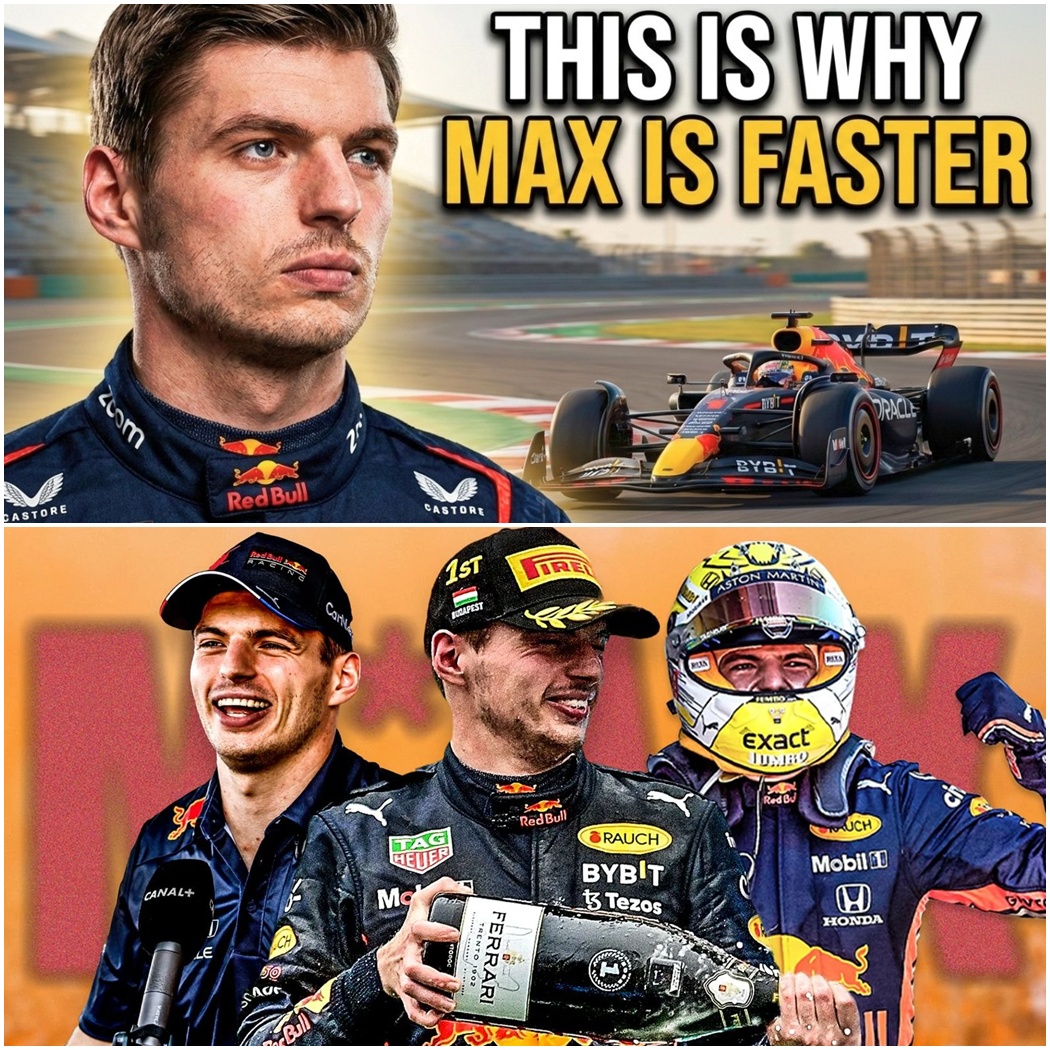
In the high-octane world of Formula 1, the narrative often centers on the machine. Critics and casual observers alike frequently point to the Red Bull garage, claiming that Max Verstappen’s dominance is merely a byproduct of superior engineering. However, a closer look at telemetry, onboard footage, and the historical struggle of his teammates tells a much more compelling story. Max Verstappen isn’t just winning; he is operating on a plane of performance that defies standard logic. Even when strapped into identical machinery, world-class drivers have found themselves unable to bridge the gap to the Dutchman. The question that haunts the paddock remains: Why is Verstappen still faster than everyone else?
The answer lies in a rare convergence of technical mastery, psychological resilience, and a driving philosophy that most find terrifying. While many drivers spend their careers searching for a “planted” car—one that feels stable and predictable—Verstappen thrives on the edge of instability. He famously prefers a car with an incredibly sharp, aggressive front end. To the average driver, such a setup feels “nervous” or twitchy, prone to losing the rear end at a moment’s notice. But for Verstappen, this instability is a tool. It allows the car to rotate mid-corner with a level of immediacy that others simply cannot handle. By rotating the car faster, he can point it toward the exit earlier, getting back on the power long before his rivals. This gain, measured in mere fractions of a second per corner, compounds over a 60-lap race into a devastating lead.
One of the most technical areas where Verstappen separates himself is in the braking zones. Most fans believe that “braking late” is the hallmark of speed, but Formula 1 is more nuanced. The real advantage comes from “trail braking”—the ability to blend braking force with steering input. Telemetry shows that Verstappen maintains a higher minimum speed through the apex of a corner . Instead of braking in a straight line and then turning, he begins the rotation while still decelerating, keeping the car balanced on a knife-edge. This requires a level of sensory feedback and car control that is almost superhuman. He isn’t just stopping the car; he is manipulating its weight distribution to maximize grip at every single millisecond of the corner entry.
Beyond the raw mechanical speed, Verstappen has mastered the “dark art” of tire management. In the modern era of Pirelli rubber, tires operate within a very narrow temperature window. Push too hard, and the surface overheats, leading to a “cliff” in performance. Drive too slowly, and the tires lose their optimal grip. Verstappen has demonstrated an uncanny ability to drive at 99% of the limit while keeping his tires in the perfect “Goldilocks” zone . While his rivals are forced to manage their pace to save their tires, Verstappen often finds himself able to maintain consistent lap times deep into a stint. This efficiency allows him to be most dangerous at the end of a race, precisely when others are at their most vulnerable.
Perhaps his most underrated trait is his adaptability. Throughout his career, Red Bull has transitioned through various technical regulations and car philosophies. Whether the car is understeering or oversteering, Verstappen finds a way to extract its maximum potential. This adaptability will be his greatest weapon as Formula 1 heads toward the radical rule changes of 2026. The upcoming era will introduce active aerodynamics and a massive shift toward electrical energy management. Drivers will no longer just be steering; they will be managing complex energy deployment strategies in real-time . While some fear this will “sanitize” the racing, the reality is that it will reward the most technically minded drivers. Verstappen’s deep understanding of his car’s systems suggests that he may not just adapt to the 2026 rules—he might exploit them better than anyone else.
Ultimately, what makes Verstappen “unbeatable” is his relentless consistency under pressure. It is one thing to produce a “purple” sector in qualifying; it is another entirely to repeat that feat for 70 laps without a single lock-up or wide exit. His ability to operate at the theoretical limit of the car’s performance, lap after lap, creates a psychological weight that crushes his opponents. They know that to beat him, they must be perfect, and in the pursuit of perfection, they often make the very mistakes that Max avoids. As we look toward the future of the sport, the evidence is clear: Max Verstappen’s speed isn’t just in the car—it’s in the way he has redefined what it means to drive a Formula 1 car at the absolute limit of human and mechanical capability.