The Banned Masterpiece: How a 100,000 RPM Loophole Terrified the Racing World
Motorsport has always been a battle fought on two distinct fronts. There is the visible war waged by the drivers on the asphalt, marked by late braking, daring overtakes, and raw reflexes. But hidden away in the sterile, brightly lit development centers of the world’s top manufacturers, a second, arguably more intense war is being fought. It is a war of attrition against the rulebook. In 2019, race engineers for a rival Formula E team were casually analyzing onboard audio recordings from their competitors. It is a standard practice in the highly secretive world of motorsport—listening to the pitch and whine of electric motors to reverse-engineer what the opposition is doing. But when they analyzed the acoustic signature of one specific car, the data made absolutely no sense.
The car in question was producing two distinct frequencies, an anomaly for a vehicle supposedly powered by a standard electric setup. Even more baffling, one of the frequencies was behaving in reverse. When the car decelerated, the secondary frequency pitched upward, indicating acceleration. When the car accelerated out of a corner, the frequency slowed down. This completely defied the conventional understanding of how electric motors operate. Unless, of course, someone had figured out an impossibly clever mechanical trick. As it turned out, a small team of engineers at Nissan had done exactly that. They had weaponized an ancient concept of physics, squeezed it through a gaping loophole in the Formula E regulations, and built a machine so radically advanced that it ultimately had to be outlawed to save the sport.
To understand the sheer genius of this invention, you have to understand the rigid constraints of modern electric racing. Dr. Chris Vag, the lead engineer on this secretive project, was given a simple but daunting brief: find more performance. However, he was not interested in scraping the bottom of the barrel for a microscopic fraction of a second. His goal was monumental. He wanted an advantage of a full second per lap. In the razor-thin margins of elite motorsport, a second per lap is not merely an upgrade; it is an entirely different category of vehicle. An advantage that large would allow a driver to completely humiliate the grid, lapping the field and crossing the finish line in a league of their own.
Achieving this required going back to fundamental first principles. In Formula E, performance is strictly bottlenecked by two factors: energy and power. The regulations enforce a hard cap on the maximum amount of energy a car can draw from its battery over the course of a race, as well as a strict limit on the maximum power output allowed at any given moment. You cannot simply install a larger battery or turn up the software to deploy more juice. The battery is sealed, and the limits are absolute. This led Dr. Vag to ask an incredibly audacious question: How could the team deliver more physical power to the wheels without actually pulling that power from the battery?
At first glance, this sounds like a blatant violation of the laws of thermodynamics. You cannot create energy out of thin air. But Dr. Vag was not trying to create energy; he was trying to store it somewhere else. He systematically evaluated every known method of energy storage. Potential energy, which involves storing energy by raising a heavy mass, was entirely impractical for a race car. Chemical energy storage is essentially what a battery does, and adding more was strictly forbidden. Nuclear energy was, for obvious reasons, entirely out of the question. This left kinetic energy—the energy of motion.
The challenge with kinetic energy in a confined space like a race car cockpit is that you cannot simply throw an object from one end of the car to the other to capture its momentum. You need motion that remains completely stationary relative to the chassis. The solution was rotation. If you can spin an object up to an incredibly high speed and keep it spinning, you effectively create a mechanical reservoir of energy that can be tapped into at will. This device is known as a flywheel.
Flywheels are far from a new technology. Ancient potters utilized them around 6,000 BC to maintain the momentum of their wheels. Leonardo da Vinci incorporated them into his mechanical lathes, and James Watt famously used them to smooth out the power delivery of his steam engines. Today, massive flywheels are used to stabilize electrical grids, capture braking energy in underground train stations, and provide uninterrupted backup power for hospitals. The physics is ancient and undisputed. The real question was whether such a heavy, cumbersome mechanism could be successfully integrated into the delicate, weight-sensitive architecture of a Formula E race car.
Technically, installing a dedicated flywheel in a Formula E car was illegal under the strict energy storage regulations. But here is where the true brilliance of the engineering team shone through. The rulebook contained a minor, almost forgotten clause stating that teams were permitted to use up to two electric motors. Almost no one took advantage of this rule because the conventional wisdom dictated that a single, highly efficient motor was the best approach. But Dr. Vag realized that the internal rotor of an electric motor is a spinning mass. If spun fast enough, that motor could act exactly like a flywheel.
There was a catch, however. The rules dictated that if two motors were used, they had to remain physically connected to the drivetrain at all times. The team could not simply install a clutch to disconnect the second motor, spin it up independently, and then drop the clutch to unleash the power. To solve this, the engineers utilized an epicyclic gearbox. Unlike a standard differential that takes one input and splits it into two outputs, an epicyclic gearbox does the reverse. It takes two inputs and combines them into one output. This allowed the two motors to be physically connected at all times, satisfying the rulebook, while still allowing them to spin at entirely different speeds independently of one another.
This dual-motor setup offered three massive advantages. First, it functioned as a continuously variable transmission (CVT). Electric motors, much like combustion engines, have an optimal operating window where they produce the most power with the least amount of wasted heat. By running two motors through the epicyclic gearbox, the team could infinitely vary the effective gear ratio, keeping both motors in their absolute peak efficiency sweet spot throughout the entire lap.
The second and third advantages revolutionized braking and acceleration. In electric racing, when a driver hits the brakes, the motor works in reverse, acting as a generator to capture the car’s kinetic energy and feed it back into the battery. But the rules capped this regenerative braking at 250 kilowatts. Any braking energy beyond that limit had to be handled by traditional mechanical brakes, turning precious momentum into useless heat. Nissan’s genius system completely bypassed this limitation. When the primary motor hit its 250-kilowatt limit, the excess braking energy was instantly diverted to the second motor, spinning it up to a blistering speed and storing that energy kinetically. Then, when the driver accelerated out of the corner, the car could draw the maximum allowable 200 kilowatts from the battery, while simultaneously dumping the stored kinetic energy from the spinning second motor directly into the drivetrain.
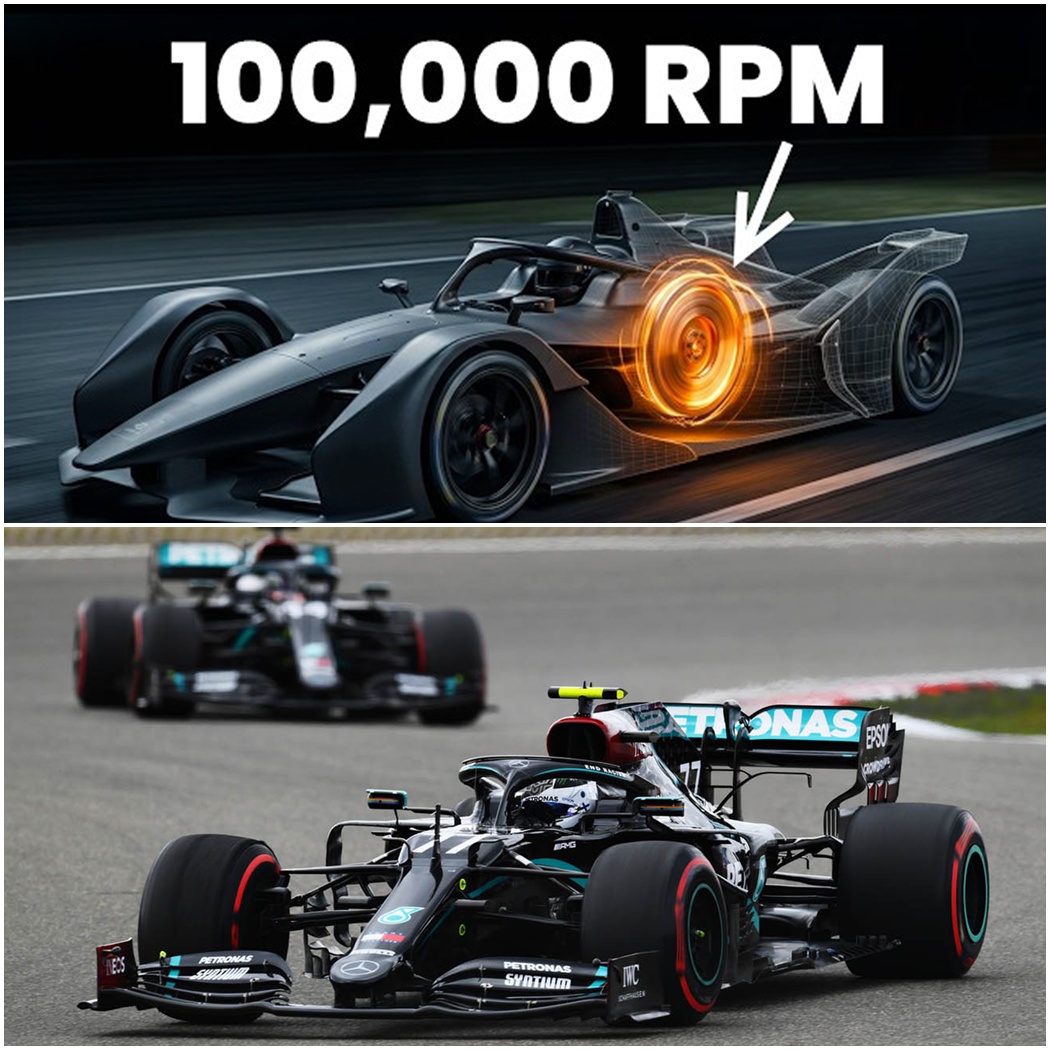
On paper, it was an unbeatable strategy. But the physical execution was a total engineering nightmare. To store enough energy to be useful without being too large or heavy, the internal mass had to spin at an astonishing 100,000 revolutions per minute. At those astronomical speeds, the centrifugal forces are so violent that the metal rotor wants to tear itself apart. To prevent catastrophic shrapnel explosions, the rotor had to be wrapped in industrial-grade carbon fiber.
Furthermore, the outer circumference of a rotor spinning at 100,000 RPM moves faster than the speed of sound. The aerodynamic friction of the air inside the casing rubbing against the metal generated so much heat that the motor would instantly melt. To counter this, the team encased the entire mechanism in a vacuum chamber. But this created yet another seemingly impossible hurdle: they had to maintain a perfect vacuum seal around a physical, rotating shaft that connected to the gearbox. The gears themselves also spun at terrifying speeds, churning up their lubricating oil so violently that the friction of the fluid alone caused massive overheating issues.
Despite these immense hurdles, the team built a functioning prototype. But when driver Sebastien Buemi took it out for its first test, it was borderline undrivable. The sheer violence of the secondary motor dumping its stored energy back into the drivetrain made the power delivery incredibly unpredictable. The car would aggressively snap into wheelspin precisely when the driver needed smooth, predictable traction exiting a corner. To make matters worse, the optimal way to use the system was far too complex for a human brain to calculate. Deciding exactly when to harvest energy, when to deploy it, and how to balance the speeds of the two motors through every single corner of a race required infinite strategic permutations.
To solve this, the team partnered with Canopy Simulations, a company specializing in advanced optimal control AI. Instead of relying on human guesswork, the simulation software tested tens of thousands of laps, simultaneously adjusting braking points, racing lines, and the infinitely complex deployment strategies of the twin motors. The AI revealed a counterintuitive secret: rather than waiting until the end of the straight to deploy the kinetic energy, the car was significantly faster if it dumped the flywheel energy immediately upon exiting the corner, saving the precious battery electrical energy for the highest-speed sections of the track.
Armed with this flawless AI-generated strategy, Nissan arrived at the first race weekend of the season. The impact was immediate and shocking. The car dominated qualifying sessions, leaving rivals scratching their heads at the sheer pace of the machine. But in race conditions, the system proved fragile. The intense heat, the added weight, and the aggressive drivability issues resulted in a devastating string of double Did-Not-Finishes. The machine that made them gods on a single lap was tearing itself apart over race distances.
Yet, the engineering team refused to back down. They painstakingly refined the software, improved the cooling, and smoothed out the power delivery. The tide began to turn. They started claiming podiums, and finally, at the penultimate round of the season in New York, Sebastien Buemi converted pole position into a flawless, dominant victory. It was Nissan’s first-ever Formula E win, a triumph of human ingenuity over rigid regulation.
What terrified the paddock most was a closely guarded secret: the team was only running the system at roughly 75 percent of its true potential. With further optimization, the car was destined to become completely untouchable.
But motorsport is as much a political game as it is an engineering challenge. Realizing that Nissan had fundamentally broken the competitive balance of the sport, rival teams aggressively lobbied the FIA. The governing body saw the writing on the wall. If the twin-motor kinetic recovery system was allowed to continue, Nissan would not just win the next season; they would completely monopolize the sport for years while competitors spent millions trying to catch up. Just weeks after the season concluded, the FIA intervened and officially banned the dual-motor setup.
The decision was a heartbreaking blow to the brilliant minds who had sacrificed years of their lives to bend physics to their will. But the legacy of the 100,000 RPM flywheel remains one of the greatest modern tales of motorsport engineering. It serves as a beautiful reminder that racing is not simply about crossing the finish line first. It is about staring at a rigid set of rules, reading between the lines, and having the sheer audacity to build something the world believed was impossible.








