The Multi-Million Dollar Nightmare: How Aston Martin’s 2026 Dream Car Became Fernando Alonso’s Worst Torment
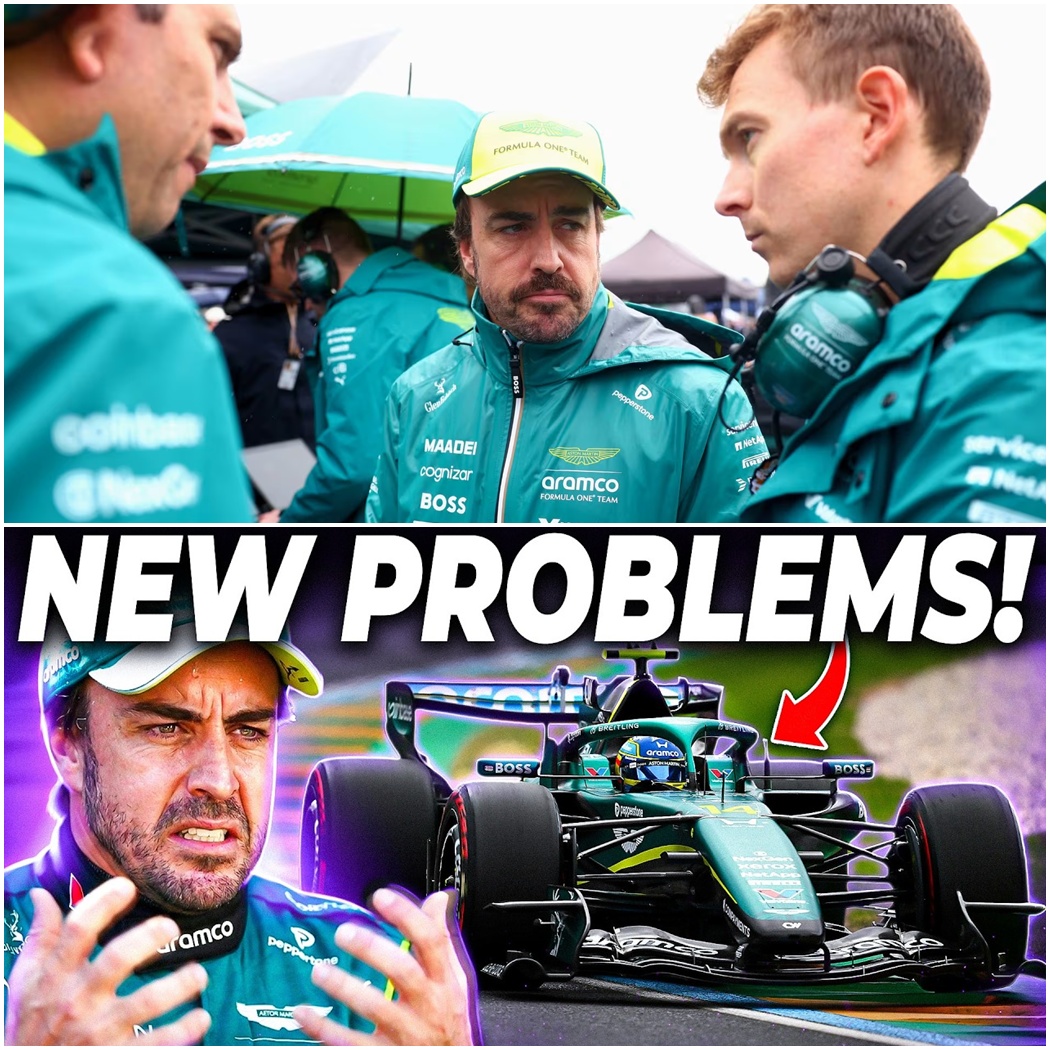
There is a singular, haunting image that perfectly encapsulates the utter devastation of Aston Martin’s 2026 racing campaign. It happened during the Shanghai Grand Prix, deep into a race that had already spiraled out of control. Television cameras mounted inside the cockpit captured a 44-year-old Fernando Alonso—a two-time world champion and one of the most fiercely competitive drivers in motorsport history—doing the unthinkable. Traveling at staggering speeds exceeding 300 kilometers per hour, Alonso took both of his hands entirely off the steering wheel. He began aggressively shaking them in the open air, desperately trying to force the blood and feeling back into his extremities. He was running dead last, a full lap behind the race leaders, piloting a machine that was not just failing him competitively, but was actively putting his physical health at severe risk.
For Aston Martin, the 2026 season was supposed to be the glorious payoff. It was meant to be the grand culmination of a multi-million dollar masterplan orchestrated by team owner Lawrence Stroll. The team had aggressively recruited Adrian Newey, universally recognized as the most successful aerodynamic designer in the history of the sport, offering him unparalleled control and resources. They had successfully lured Honda back into the sport to provide a dedicated, factory-backed power unit. They had poured hundreds of millions of dollars into a state-of-the-art wind tunnel and factory facilities at Silverstone. When Alonso signed his contract extension, he did so believing he was securing a seat in a championship-contending car for the final chapter of his legendary career. Instead, what he received was the slowest, most dangerously flawed vehicle on the starting grid.
The crisis began long before the first official race of the season. During pre-season testing in Bahrain, alarming reports began to surface regarding the Honda RA626H power unit. It was not a matter of pure speed, but rather a violent, uncontrollable vibration. The engine shook so ferociously that it actively destroyed the car’s intricate hybrid batteries. In a sport governed by a strict cost cap where drivers are limited to just two battery units for the entire year, this was a catastrophic realization. The team knew they were facing a critical design flaw, but with the season opener looming, they had no choice but to race anyway.
The consequences of that decision became terrifyingly apparent at the Australian Grand Prix in Melbourne. The violent vibrations resonating through the chassis of the AMR26 were so severe that Alonso could not safely complete more than 25 laps without risking permanent nerve damage to his hands and wrists. His teammate, Lance Stroll, faced an even shorter threshold, maxing out at roughly 15 laps before losing feeling in his fingers and feet. The situation had escalated from a mere technical grievance into a genuine medical emergency. The fundamental pace of the car seemed to exist somewhere buried deep within the chassis—Alonso managed to drag the car from 17th on the grid up to 10th in the opening laps—but the physical toll was completely unsustainable. Aston Martin ultimately had to pull him into the pits to protect his body, eventually retiring him from the race entirely. Neither car saw the checkered flag that afternoon.
The root cause of this nightmarish scenario was not simply a faulty engine, but rather a fatal flaw in the overarching design philosophy of the AMR26. In an aggressive pursuit of aerodynamic supremacy, Adrian Newey and his engineering team made the deliberate choice to tightly package the internal components. To free up crucial airflow space at the rear of the car, the team stacked the heavy hybrid battery directly on top of the delicate electronics, pushing the MGUK further ahead of the engine block. While this gave Newey the sleek aerodynamic canvas he desired, it inadvertently created a lethal acoustic chamber. The specific vibration patterns generated by the new Honda engine perfectly matched the resonant frequencies of the chassis. Instead of absorbing the shock, the carbon fiber body of the AMR26 acted like a giant speaker box, amplifying the violent shaking until the internal components literally tore themselves apart.
With a brutal race calendar offering no breathing room, Honda was forced to implement a blunt, desperate, and highly restrictive short-term fix. They artificially lowered the RPM ceiling of the engine, which marginally reduced the shaking but severely crippled the car’s straight-line speed. It was a band-aid on a bullet wound. Aston Martin desperately needed time to re-engineer the car, a luxury that simply does not exist in the relentless world of top-tier motorsport.
However, a sudden geopolitical conflict in the Middle East resulted in the unexpected cancellation of both the Bahrain and Saudi Arabian races in April. This unprecedented five-week gap was a lifeline. It provided Honda with the critical window needed to ship a complete AMR26 chassis directly to their secretive Sakura research facility in Japan. Placing the car on a sophisticated test rig, the engineers worked around the clock to isolate the destructive frequencies and manufacture updated structural components.
When the Formula 1 circus finally arrived at the Miami Grand Prix, Aston Martin believed they had weathered the storm. The updated car took to the track, and for the first time all season, the violent shaking was gone. Alonso and Stroll reported that the car finally felt “normal.” Both drivers successfully completed the sprint and the main race without suffering battery failures or physical torment. But in the ruthless arena of motorsport, solving one fatal flaw often just exposes the next weakness hiding directly beneath it.
The vibration crisis had essentially acted as a smokescreen, masking a deep, fundamental deficiency in Aston Martin’s brand-new, in-house gearbox. In previous seasons, the team had reliably purchased their transmission components from rival constructors. For 2026, as part of their push to become a fully independent powerhouse, they designed and built the gearbox themselves. And it failed spectacularly.
During the crucial qualifying session in Miami, Alonso found himself wrestling with a car that was fundamentally broken. The connection between the complex electronics and the mechanical gearbox began severing intermittently. The car started suffering from violent, random downshifts. It was bleeding speed out of the corners, and the rear wheels were locking up without any warning upon corner entry. Alonso bluntly described the machine as “impossible to drive,” noting that if these random downshifts had occurred in wet weather conditions, the car would have been completely lethal.
This cascading sequence of failures has left Aston Martin languishing at the absolute bottom of the constructor’s championship. They sit dead last—11th out of 11 teams—having scored zero points. They are routinely being outperformed by Cadillac, a brand-new team competing in their very first season, and by organizations operating on a fraction of Aston Martin’s astronomical budget. The qualifying gaps are frankly embarrassing. During the sprint shootout in Miami, Alonso’s fastest clean lap was actually slower than the worst qualifying time posted by a junior-level Formula 2 car. Aston Martin is not just suffering a temporary dip in form; they are in an unmitigated freefall.
The pressure inside the team is reaching a boiling point, largely because the usual escape routes are blocked by the harsh realities of modern regulations. In 2009, when Adrian Newey faced a similarly sluggish start with Red Bull Racing, the team simply spent their way out of the problem, utilizing limitless resources to develop their way to the front of the grid. That is no longer possible. Under today’s strict financial cost cap, every single dollar spent trying to salvage the broken 2026 chassis is a dollar stolen from the development of the 2027 car. The margin for error is razor-thin, and major upgrades have been entirely paused until the engineering team can truly understand why their wind tunnel data has failed to correlate with the brutal reality of the racetrack.
But perhaps the most agonizing element of this entire saga is the human cost, specifically regarding Fernando Alonso. At nearly 45 years old, time is the one resource that neither he nor the team can manufacture. He has lived this exact nightmare before. Between 2015 and 2018, Alonso sacrificed his prime years driving a profoundly uncompetitive McLaren-Honda, watching top-tier engineers completely fail to unlock speed from a fundamentally flawed concept. He eventually walked away from the sport in deep frustration, seeking out victories in endurance racing and the grueling Indianapolis 500. He returned to Formula 1 specifically because he believed the Aston Martin project, backed by Lawrence Stroll’s billions and Adrian Newey’s genius, would be different.
Instead, he finds himself trapped in a depressing sense of deja vu, answering the same repetitive questions from the media with an aura of practiced, exhausted patience. When asked in Miami if securing a top-five finish would convince him to sign a contract extension, Alonso offered a hollow laugh, stating that if he miraculously finished fifth, he would probably retire on the spot. He knows the truth: a single strong result with this chassis would be a stroke of blind luck, not a sign of systemic progress.
Meanwhile, his teammate Lance Stroll is directing his simmering frustrations at the rulebook itself, publicly declaring that the heavy, cumbersome 2026 cars are simply not fun to drive, unfavorably comparing them to the lower-tier Formula 3 machines he tested during the break. But while Stroll enjoys the ultimate job security provided by his father’s ownership of the team, Alonso is facing the twilight of his career staring at the back of the grid.
As the paddock packs up and prepares for the upcoming Canadian Grand Prix in Montreal, the anxiety within Aston Martin is palpable. The Circuit Gilles Villeneuve is notorious for its brutal, heavy braking zones and long straights leading into tight chicanes. If the terrifying random downshift issue that plagued the gearbox in Miami reappears on the unforgiving walls of Montreal, it will definitively prove that the team is facing a deeply embedded structural crisis rather than a one-off electronic glitch.
Aston Martin promised the world a championship contender. They hired the greatest designer, secured a legendary engine partner, and signed a generational talent behind the wheel. But the grim reality of the 2026 season has proven that money and big names cannot simply buy performance. Every engineering fix merely peels back a layer to reveal a darker, more complex failure hiding underneath. For Fernando Alonso, the wait for a competitive car has transitioned from a test of patience into a tragic race against the clock—a race that, right now, he is undeniably losing.