Is Formula 1 Engineering Its Own Death? Why the Quest for Perfection is Killing the Soul of Racing
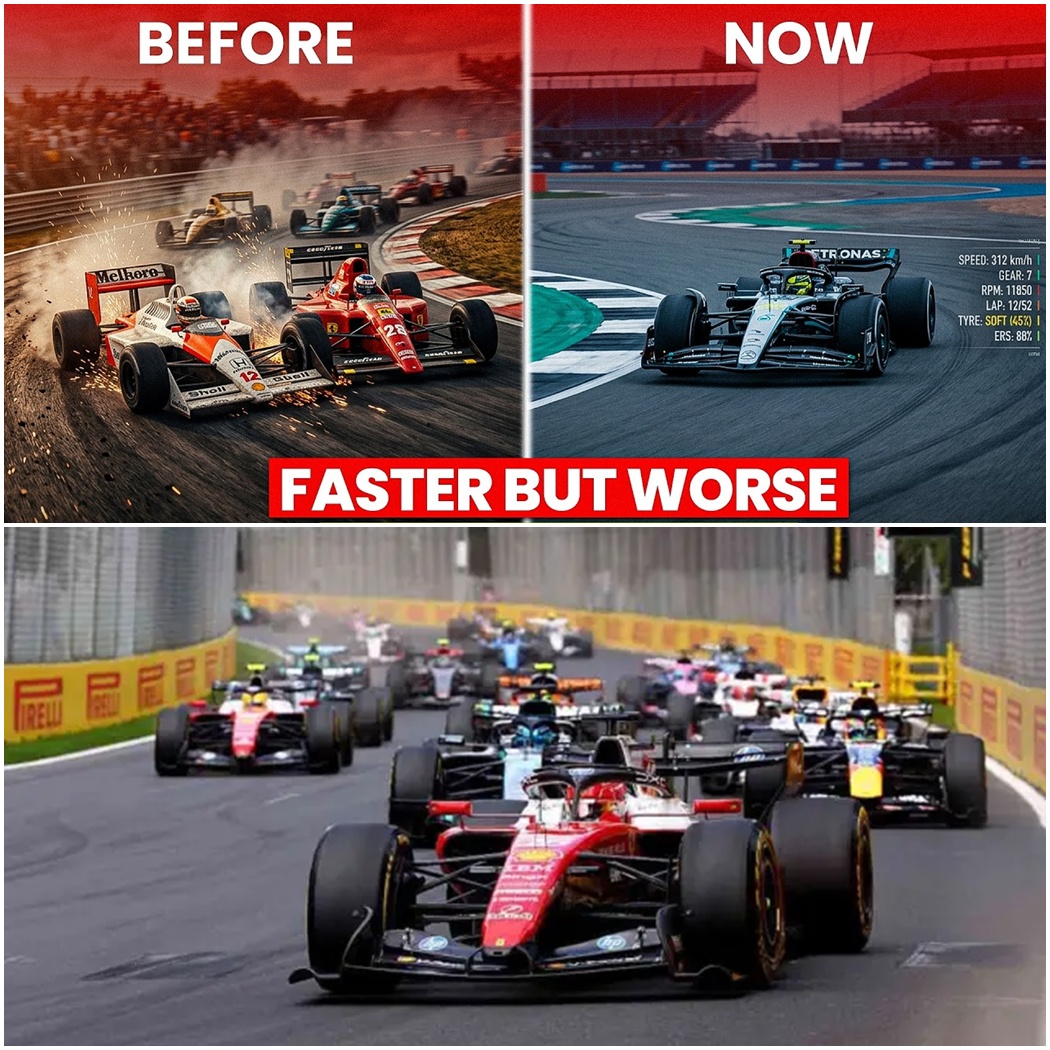
Picture this: It’s Monza in 1988. Ayrton Senna is leading the pack, but his eyes are darting to the mirrors. Lurking right behind him is a familiar shadow—his own teammate, Alain Prost. Prost is pushing Senna into a terrifying psychological trap. Prost knows his own engine is dying, but he turns up the boost anyway, forcing Senna to burn through his precious fuel just to maintain the lead. It’s a high-speed game of chicken between two men who genuinely despise each other. They are fighting for a world championship in cars that felt like they actively wanted to kill them. The crowd is on its feet, roaring over the deafening engines. Nobody is looking down to check a data overlay on their phones. They are entirely captivated, watching two human beings operate at the absolute edge of what is physically and psychologically possible.
Now, fast forward to a modern setting: Monza 2025. Max Verstappen casually puts in a qualifying lap at a mind-bending average speed of 264 km/h—the fastest in the circuit’s rich history. The engineering behind this feat is undeniably extraordinary. The numbers are genuinely historic, breaking records that engineers two decades ago could only dream of. Yet, across social media platforms, in passionate fan forums, and in hushed conversations between veterans who have faithfully watched this sport for thirty years, the exact same question keeps surfacing: If the cars are better, faster, and more advanced than they have ever been, why doesn’t the racing actually feel better?
The answer, surprisingly, isn’t about speed. It is about what speed fundamentally changed. This crucial distinction is the heart of a growing crisis of identity within the world’s most glamorous motorsport.
Start with memory, because that is exactly where every longtime Formula 1 fan starts. If you ask someone who fell in love with Formula 1 in the gritty 1980s or the roaring 1990s what they remember most vividly, they will never cite a lap time. They will not quote a telemetry chart or an aerodynamic efficiency metric. Instead, they will give you a moment.
They will recall Senna and Prost colliding spectacularly at Suzuka in 1990—a singular moment so heavily loaded with bitter rivalry and monumental consequence that people still passionately argue about who was at fault today. They will talk about Michael Schumacher and Mika Häkkinen at Spa in 2000, two titans trading positions through the terrifying Eau Rouge at speeds that made veteran commentary teams entirely lose their composure. They will reminisce about a young Fernando Alonso desperately holding off a relentless Schumacher at Imola in 2005 in a grueling battle that lasted lap after agonizing lap, neither driver willing to yield a single centimeter of asphalt.
Even in more recent memory, fans cling to human conflict. They remember Lewis Hamilton and Nico Rosberg at every race weekend between 2014 and 2016—two childhood friends turned bitter teammates fighting for the same championship with everything on the line. And, of course, the explosive 2021 season where Hamilton and Verstappen engaged in a rivalry so intensely visceral that it literally fractured the paddock and generated more global discussion than any season in a generation. Fans remember the battles. They remember the psychological warfare. They do not remember the lap times. And that psychological truth sits at the very heart of the modern Formula 1 dilemma.
There is a growing, undeniable debate about whether modern Formula 1 can still produce rivalries with the same emotional weight. Some fans argue that the sport has never been more globally popular, often pointing to the Netflix-fueled boom and that explosive 2021 finale as definitive proof that the raw drama is still very much alive. However, the other side of the aisle argues that something vital in the texture of the racing—the unpredictability, the rawness, the terrifying sense that absolutely anything could happen—has been gradually, systematically engineered away.
Both camps have a valid point, and the reason is simply that the sport got faster and vastly more optimized. Optimization alters the spectacle in ways that are deeply insidious and difficult to see until you step back and examine the entire historical picture.
There is a very real physical cost to all this technological progress. As the modern hybrid beasts found more aerodynamic grip and straight-line speed, the literal space available for racing began to shrink. When cornering speeds increase to the physics-defying levels we see today, the dynamics of overtaking change fundamentally. Braking zones—historically the primary theater for wheel-to-wheel combat—have been aggressively compressed into split-second windows. At legendary, flowing circuits like Silverstone and Barcelona, modern F1 cars carry so much momentum through medium and high-speed corners that the vital opportunities for a genuine, lunging move have narrowed considerably. The cars are simply too fast through the sections where overtaking is hardest, and the zones where a pass was once highly possible have been swallowed whole by the sheer performance envelope of the modern machinery.
Alongside this, the aerodynamic philosophy of modern Formula 1 has inadvertently produced cars that are extraordinarily fast in clean air, but significantly, cripplingly compromised in turbulent air. The much-hyped 2022 regulations were supposed to fix this. Initially, they did improve things meaningfully—downforce loss at close following distances dropped from around 50% to a much more manageable 15-20% in the first season. But by 2025, as brilliant engineers ruthlessly pushed the regulations to their absolute limits, that figure deteriorated significantly. The cars were essentially optimized right back toward the exact problem the massive regulation overhaul was designed to solve.
When performance margins shrink to the microscopic levels they exist at in modern Formula 1, racing becomes a heavily controlled exercise. Drivers are no longer fighting unstable, violently unpredictable machines. Instead, they are managing extraordinarily precise instruments within incredibly narrow performance windows. Modern F1 heavily rewards robotic perfection much more than brilliant improvisation, and that profound shift changes the character of the racing in ways that fans intuitively feel, even when they cannot fully articulate why.
Then, there is the undeniable weight problem. The 2022 generation of Formula 1 cars weighed in at a staggering minimum of 798 kg—the heaviest in the sport’s seven-decade history. For stark context, the cars of the early 1990s—the nimble, twitchy machines that largely defined the golden era of wheel-to-wheel combat—tipped the scales at a mere 505 to 600 kg. The upcoming 2026 regulations finally attempt to take a swing at this, trimming the fat down to 768 kg. It is a step in the right direction, but still a tremendously far cry from the light, agile machines of the ’90s.

Weight dictates racing in ways that are immediately visible to the naked eye. Heavier cars require significantly longer braking distances, but more importantly, they place immense, sustained stress on the tires. This fundamental reality completely changes how drivers approach a grand prix. A driver in a 500 kg car could push to the absolute limit for lap after lap without instantly destroying their tires. A driver in a modern 800 kg behemoth is constantly, obsessively managing tire temperatures, wear, and thermal degradation. These limitations dictate exactly how much genuine aggression they can actually afford to show on track.
In earlier eras, the car was an adversary just as much as it was a tool. World Champion Nigel Mansell famously described his brutal 1986 Williams as a machine that genuinely wanted to kill him on a bad day. That terrifying relationship—the palpable sense that the driver was genuinely wrestling something dangerous and untamed into submission—created a very specific kind of intoxicating drama that modern Formula 1 simply cannot replicate. Modern cars are not designed to be wrestled; they are meticulously designed to be managed.
Many legacy fans feel the balance of power has shifted from ‘driver versus driver’ to ‘engineer versus engineer.’ Formula 1 has, of course, always been an engineering sport, but the very nature of that engineering has changed its focus. Drivers now arrive at the track having already driven the upcoming race a thousand times in a multi-million-dollar simulator. Every bump, every braking marker, every curb, and every single gear shift has been endlessly practiced and perfected in a digital vacuum. The first lap of practice isn’t a thrilling voyage of discovery anymore; it is merely an execution of a pre-calculated software program. When a crucial race position is ultimately determined by a tire undercut, executed perfectly by a backroom strategy team monitoring 17 different live data streams, the driver’s role is reduced to executing the plan, not improvising one.
Mechanical reliability has also fundamentally changed the sport in ways that nostalgia tends to dramatically understate. In the 80s and 90s, mechanical failure was a constant, looming threat over every single race. Engines spectacularly blew into plumes of white smoke; gearboxes violently failed without warning. A driver leading a race with just 10 laps to go had absolutely no guarantee of crossing the finish line. That brutal uncertainty created a thick tension that modern F1 has largely eliminated. Today’s cars are bulletproof engineering marvels. Uncertainty creates drama; reliability reduces uncertainty. Strategy has become the defining battleground—tire windows, energy deployment, undercut timing. It is a game of high-speed chess, but for many, the board has become a little too predictable.
Furthermore, we must address the human element. The digital evolution didn’t just optimize the cars; it optimized the drivers. In the past, a driver could be a hero, a villain, or a complete recluse—often all three in a single weekend. Today, every word is carefully managed by a hovering PR team, and every emotion is filtered through a sterile, brand-friendly lens. The raw humanity fans miss isn’t just about the driving style; it’s about the personality. We traded the wild, unpredictable humanity of legendary mavericks for a generation of elite athletes who must be as aerodynamically smooth in a post-race interview as their cars are on the main straight.
Formula 1 didn’t just become faster; it became solved. Optimization, by its very nature, mercilessly chokes out the remaining space where chaos, human error, and brilliant improvisation once lived. The upcoming 2026 regulations represent the sport’s most serious attempt yet to recalibrate this delicate balance. But whether they succeed will depend on whether Formula 1 can honestly answer a question it has been avoiding for a decade: Are modern Formula 1 cars too complex to produce the kind of racing that made fans fall in love with the sport in the first place?
Would fans happily accept noticeably slower cars if the racing was significantly more physical, more aggressive, and more human? If Formula 1 successfully builds the fastest cars in human history but entirely loses the breathtaking battles and the thrilling sense that anything could happen, then the sport has to ask itself what actually makes it great. Are we building toward the ultimate racing spectacle, or are we quietly, incrementally, optimizing the soul of the sport away?








