The Invisible Edge: The Terrifying Physics Behind How Max Verstappen Controls a Formula 1 Car at the Absolute Limit
In the hyper-competitive, high-stakes arena of modern Formula 1, the difference between glorious victory and devastating failure is often measured in millimeters and milliseconds. When humans are strapped into carbon-fiber missiles capable of traveling at well over two hundred miles per hour, generating gravitational forces that would render the average person unconscious, the natural instinct is self-preservation. For the vast majority of elite drivers on the grid, the smartest and safest way to navigate a race is to operate just a fraction of a percent below the car’s absolute limit of grip. Leaving a tiny margin of safety ensures stability, preserves tire life, and prevents catastrophic crashes.
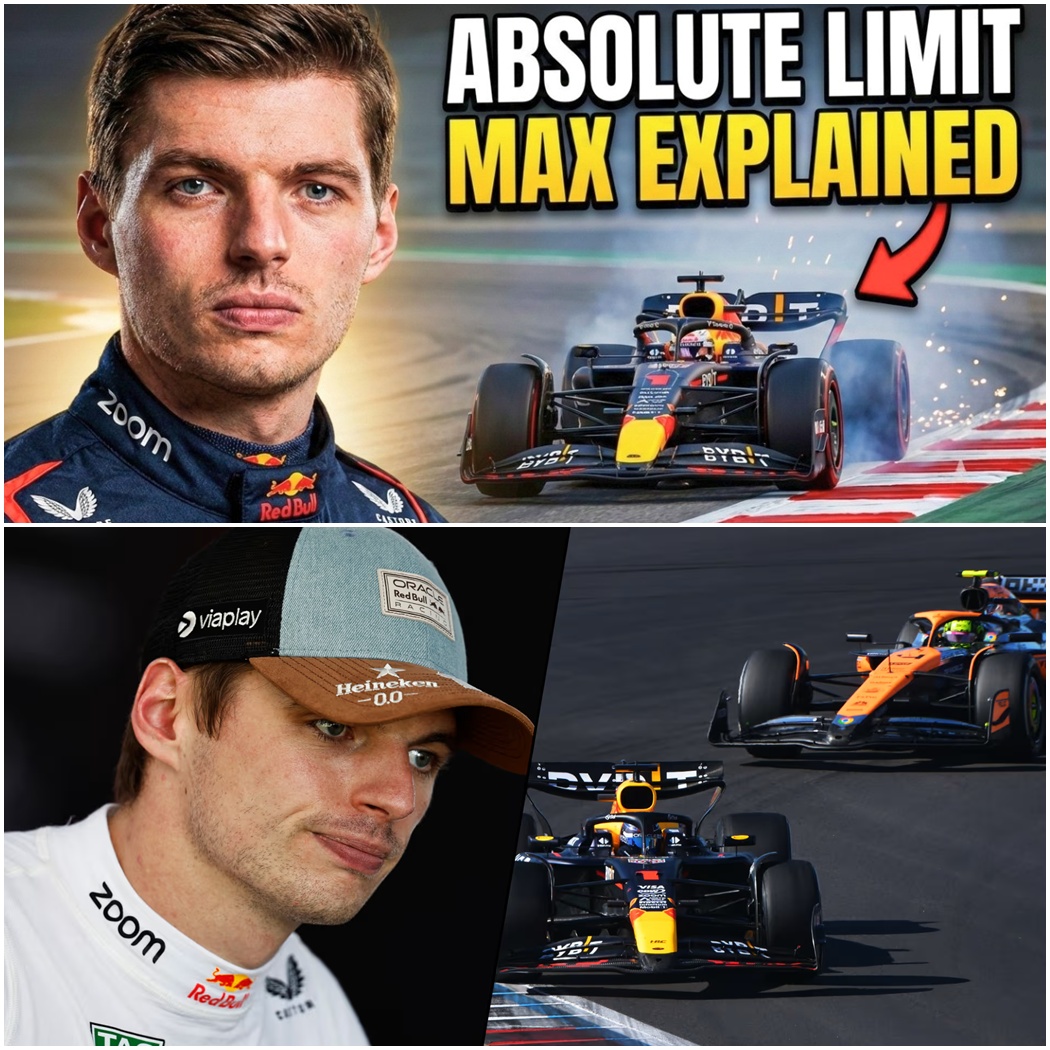
However, there is a glaring, unavoidable anomaly at the very front of the grid. Max Verstappen does not believe in safety nets. Exhaustive telemetry comparisons and detailed onboard video analyses have revealed a stunning truth: Verstappen regularly drives his car exactly on the jagged edge of instability . He deliberately operates in a highly volatile zone where the car is constantly threatening to break traction. It is a space where the microscopic difference between finding maximum cornering speed and suffering a high-speed spin is almost impossible to feel for a normal driver. Yet, this terrifying territory is exactly where the Dutchman sets lap times that leave his rivals utterly bewildered. To truly appreciate his dominance, we must dissect not just why he is phenomenally fast, but the underlying physics of how he controls a Formula 1 car at the absolute limit.
The Anatomy of the Limit
To understand what makes Verstappen’s approach so alien, we must first define what “the limit” actually represents in the context of motorsport. A Formula 1 car essentially sticks to the asphalt through a delicate marriage of two forces: mechanical tire friction and immense aerodynamic downforce. As the car travels faster, the meticulously sculpted wings and underfloor tunnels punch through the air, pushing the chassis down into the track surface . This immense vertical load squashes the tires into the tarmac, vastly increasing their grip and allowing the driver to carry mind-bending speeds through corners.
However, this grip is not infinite, and its boundary is razor-thin. Tires generate their maximum grip when they are pushed slightly sideways into a corner, an angle known to engineers as the “slip angle.” Hit the optimal slip angle, and the car corners flawlessly. Push even a fraction of a degree past it, and the tire’s performance drops off a cliff . The car will violently lose traction, resulting in rapid understeer (sliding forward) or snap oversteer (the rear end breaking loose).
Because the penalty for exceeding this limit is so severe, most top-tier drivers approach it with immense caution. Going over the limit, even for a split second, forces the driver to violently correct the steering, which scrubs off valuable speed. Worse still, sliding severely overheats the surface of the Pirelli tires, permanently degrading their grip for the remainder of the race stint . Therefore, drivers naturally seek a stable, predictable car. A stable car inspires confidence, and confidence breeds consistency. But Verstappen fundamentally rejects this philosophy. By seeking comfort, his rivals leave a tiny pocket of unused grip on the table. Verstappen, on the other hand, is willing to endure a nervous, twitchy, aggressively unstable car if it means he can extract 100% of its available performance .
The Art of the Micro-Correction
Watching Verstappen’s onboard camera is like watching a masterclass in high-speed bomb defusal. The first place his otherworldly control becomes visually apparent is in his steering inputs. The steering system of a Formula 1 car is hyper-sensitive; turning the wheel even a few degrees translates to a massive change in the vehicle’s trajectory. Heavy-handed, reactive steering increases tire slip and instantly bleeds away lap time.
Verstappen counters this by utilizing an endless sequence of microscopic steering adjustments . Rather than turning into a corner and waiting for the car to inevitably slide before wrestling it back into line with a massive correction, he is constantly feeding tiny, fluid movements into the wheel. These micro-corrections act as an ongoing dialogue between the driver and the front tires, constantly adjusting the load to maintain that perfect, elusive slip angle. He catches the slide before it has even truly begun to manifest, keeping the car balanced perfectly on the edge of the blade.
Braking on a Knife’s Edge
But steering is only one half of the cornering equation. In many ways, Verstappen’s true magic happens before he even turns the steering wheel. In a Formula 1 car, the braking zone is not simply about reducing straight-line speed; it is an incredibly violent phase of weight transfer designed to prime the car for the upcoming corner.
When a driver smashes the brake pedal, the immense deceleration forces the weight of the car to shift violently forward, squashing the front suspension and drastically increasing the grip available to the front tires Verstappen exploits this physical phenomenon through a masterful technique known as “trail braking.” Instead of doing all his braking in a straight line, completely releasing the pedal, and then turning the steering wheel, he blends the two actions together . He gently bleeds off the brake pressure as he simultaneously increases the steering angle.
This intricate dance allows the rear of the car to rotate gracefully around the apex while still bleeding off speed. It essentially shortens the braking zone, allowing him to carry significantly higher speeds into the corner while maintaining absolute directional control . Managing the brake pressure so delicately while experiencing 5G of deceleration is a physical and mental feat that very few drivers can execute consistently without locking the wheels.
The Post-Apex Phase: Throttle Mastery and the Long Game
Verstappen’s superiority doesn’t vanish once he reaches the middle of the corner. In fact, his advantage often compounds during the exit phase. As the car passes the apex, the driver must begin applying the throttle. This is a moment of immense vulnerability. If a driver aggressively stamps on the accelerator, the nearly 1,000 horsepower delivered by the hybrid power unit will instantly overwhelm the rear tires, causing wheelspin. Wheelspin looks dramatic, but it ruins lap times and destroys the fragile surface of the rear tires.
To combat this, the fastest drivers must balance the engine’s torque seamlessly with the rising level of rear grip as the car straightens out . Verstappen’s right foot possesses a level of sensitivity that is virtually unmatched. He applies the power so progressively that the car lunges forward with maximum traction, entirely avoiding counter-productive wheelspin. Because he gets on the power earlier and more smoothly, he carries a higher exit speed . This might seem like a minor detail, but a fraction of a mile-per-hour advantage at the exit of a corner compounds all the way down the following straight, resulting in massive chunks of lap time gained.
Furthermore, this buttery-smooth throttle application is the ultimate secret to his devastating race pace. By preventing his rear tires from lighting up and overheating, he drastically reduces his tire degradation . This is the exact reason why Verstappen often looks like he is in a different category entirely during the second half of a Grand Prix, effortlessly pulling away while his rivals grapple with badly worn rubber.
The Sixth Sense: Anticipation and Consistency
Motorsport engineers frequently state that if a driver has to consciously react to a slide, it is already too late. Human reaction times simply cannot keep up with the violent physics of a Formula 1 car losing grip at 150 miles per hour. This highlights perhaps the most invisible, yet critical, element of Verstappen’s brilliance: anticipation.
Through the subtle vibrations of the steering column and the physical forces translating through his custom-molded seat, Verstappen possesses a seemingly telepathic ability to predict exactly what the car is going to do before it actually happens. He feels the grip fading a fraction of a second before the telemetry even registers a loss of traction. Because he anticipates the instability, his corrections are proactive rather than reactive.
What truly elevates Verstappen to legendary status is not that he can reach this terrifying limit once during a magical qualifying lap, but that he can live there indefinitely. He operates in this hyper-focused, high-risk zone lap after lap, race after race, exhibiting an absolutely terrifying level of consistency .
The 2026 Threat: Why Rivals Should Be Terrified
If the current grid feels helpless against his dominance, the future paints an even bleaker picture for his challengers. The sport is hurtling toward a massive regulatory overhaul in 2026. The new generation of Formula 1 cars will feature complex active aerodynamics, allowing the cars to shape-shift between high downforce and low drag configurations mid-lap .
Crucially, these upcoming cars are heavily projected to produce significantly less overall downforce than the current machines. Less aerodynamic load fundamentally means a car will be far more nervous, skittish, and heavily reliant on a driver’s raw mechanical car control . The balance of the chassis will be constantly shifting throughout a single lap, creating an inherently unstable platform. While other drivers will undoubtedly struggle to find confidence in a car that refuses to stay planted, Verstappen has spent his entire career seeking out and thriving in exactly those conditions .
Max Verstappen’s reign over Formula 1 is not the result of a single driving trick or a dominant engine. It is the breathtaking culmination of steering precision, peerless braking control, delicate throttle modulation, and an eerie, predictive sixth sense . He has mastered the terrifying physics of the invisible edge. The daunting reality for the rest of the motorsport world is not a question of whether Verstappen can continue to find the absolute limit of a race car, but whether anyone else will ever be brave enough, or skilled enough, to join him there.








