The Invisible Edge: How Lewis Hamilton’s “Straight-Line” Cornering Technique is Rewriting the Laws of Formula 1 Physics
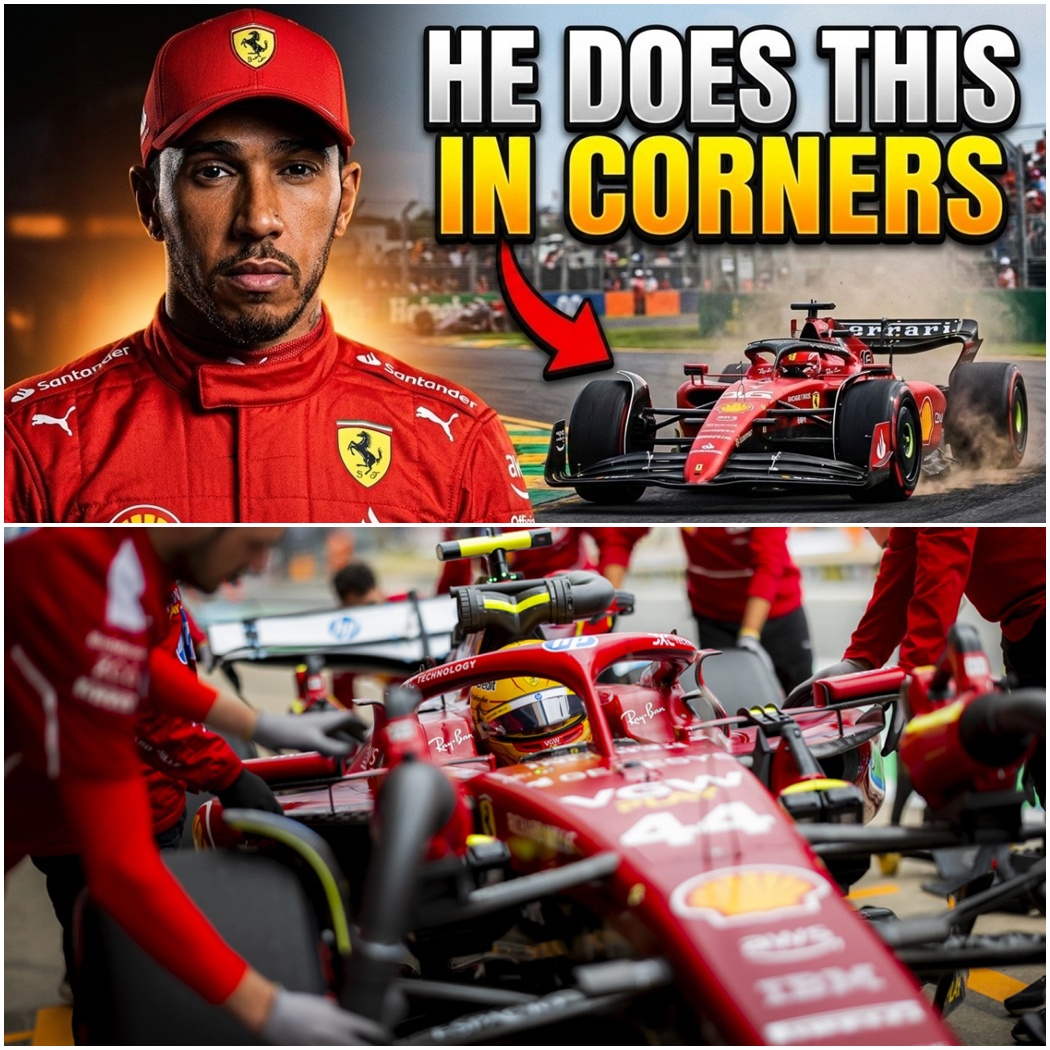
In the world of Formula 1, the visual representation of speed is often violent. We are accustomed to seeing the car’s rear end twitching as it searches for traction, the driver’s hands working feverishly at the steering wheel to make micro-corrections, and the smell of tortured rubber as tires slide across the asphalt. This is the “theatre of the limit,” where the best drivers in the world wrestle a thousand-horsepower beast through a corner. Yet, for over two decades, one driver has consistently challenged this visual narrative. When Lewis Hamilton enters a high-speed corner, the drama seems to evaporate. The car looks calmer, the movement is smoother, and the steering wheel remains almost eerily quiet in his hands . To the casual observer, it might appear that he is driving well below the limit—until the timing screens flash purple.
For years, the paddock has whispered about “the Hamilton effect.” Engineers and rival drivers have studied his onboard footage, searching for the source of his pace. Recent telemetry analysis has finally provided a concrete answer to this mystery: Lewis Hamilton keeps the car straighter than anyone else on the grid . This isn’t just a matter of style; it is a profound mastery of vehicle dynamics and tire efficiency that allows him to generate competitive speed while appearing to exert less effort. To understand how he does this, we have to look beneath the surface of the racing line and into the delicate world of “yaw angles” and “slip.”
Normally, when a Formula 1 car enters a corner, the driver relies on “rotation.” This involves getting the front tires to bite and allowing the rear to slide slightly outward, pointing the nose of the car toward the apex . This small amount of sliding is a fundamental part of racing; tires actually need to slip slightly to generate the lateral force required to change direction . Most drivers use this slip to “pivot” the car, often making visible corrections mid-corner as the grip levels fluctuate. However, telemetry comparisons show that Hamilton’s car moves differently. His steering angles are consistently smaller, and his rotational movement is noticeably lower . Instead of relying on a dramatic “pivot,” his car remains more aligned with the direction of travel, following a cleaner trajectory through the arc of the corner .
This brings us to the concept of the “yaw angle”—the measure of how much a car is rotated relative to the path it is following. A high yaw angle means the car is pointing sideways as it travels forward, which is a classic way to generate quick rotation. Hamilton, however, consistently produces lower yaw angles . By keeping the car more aligned with its path, he reduces the amount of energy wasted through lateral friction. When a tire slides sideways, a portion of its available grip is used up simply overcoming friction that doesn’t contribute to forward momentum . By reducing this “wasted” sliding, Hamilton allows his tires to operate in their most efficient range, using a greater portion of their grip for productive work .
The technical implications of this style are enormous, especially in the context of the 2026 regulations where tire management and energy efficiency are paramount. In long, high-speed corners, heat builds up rapidly in the tire’s construction. Drivers who rely on large slip angles to rotate their cars often find that their grip “fades” mid-corner as the tires exceed their thermal limits . Because Hamilton’s approach is smoother and uses smaller slip angles, his tires maintain stable grip for longer periods . This allows him to maintain a higher minimum speed through the center of the corner, often finding those crucial hundredths of a second that others lose to overheating.
Furthermore, this “straighter” technique provides a massive advantage on the exit of the corner. When a car is sliding heavily mid-corner, the driver often has to wait for the rear tires to regain full traction before they can pin the throttle. If they accelerate too early while the car is still rotating, they risk a spin or excessive wheelspin. Because Hamilton’s car remains more aligned with the path, he can transition to acceleration much more smoothly and often significantly earlier . The cleaner alignment reduces the risk of instability, allowing the car to “hook up” and rocket onto the following straight with maximum efficiency .
What is perhaps most impressive is that this isn’t a result of a specific car setup or a lucky era of dominance. Engineers have observed these same smooth patterns in Hamilton’s driving across multiple seasons and wildly different car designs. Whether he was in a championship-winning Mercedes or a car that struggled with fundamental balance, his technique remained the same: calm steering, minimal corrections, and a focus on keeping the platform stable . It is a “human-to-machine” interaction that transcends the hardware provided to him. It reflects a level of technical sensitivity where he can feel the exact point at which a tire begins to waste energy through sliding and instinctively backs away from that edge.
This “invisible” speed is why Hamilton is often described as one of the smoothest drivers in history. It isn’t just about looking elegant for the cameras; it is about the brutal efficiency of physics . In an era where every team has access to the same data, the fact that Hamilton can still find an edge by manipulating the car’s yaw angle is a testament to his generational talent. It also explains why he can be so devastating in race conditions. By using the tires more efficiently in every single corner, he saves a tiny amount of rubber and energy every lap. Over a 60-lap race, those “tiny” savings compound into a massive strategic advantage, allowing him to extend stints or push harder when his rivals’ tires have already “fallen off the cliff.”

As we look toward the future of the sport, this lesson in efficiency becomes even more relevant. In Formula 1, the fastest way through a corner is not always the most dramatic one . Sometimes, the biggest advantage comes from doing less—from keeping the car just a little bit straighter than everyone else. Once you understand the telemetry behind Hamilton’s calm steering, the onboard footage transforms. What once looked like a conservative lap now reveals itself as a masterclass in precision. The “quiet” steering wheel is not a sign of a driver taking it easy; it is the sign of a driver who has mastered the art of using grip more efficiently than anyone else in history .
Ultimately, the “Hamilton way” is a reminder that in the search for peak performance, the most powerful tool is often the one that is hardest to see. It is the subtle alignment of the car, the minimal slip of the tire, and the disciplined movement of the hands. As the 2026 season approaches, and the grid becomes tighter than ever, these microscopic technical advantages will define who stands on the podium. And if history is any guide, the driver who stays the straightest will likely be the one standing on the top step.








