The Great Ferrari Deception: Is Lewis Hamilton Hiding the SF-26’s Terrifying True Pace Behind a Childlike Smile?

The world of Formula 1 is no stranger to the art of the “sandbag”—the calculated practice of hiding a car’s true potential during testing to lure rivals into a false sense of security. But as the 2026 season dawns, bringing with it the most radical technical overhaul in decades, the whispers surrounding the Ferrari garage have reached a fever pitch. At the center of this storm is a man who has seen it all: Sir Lewis Hamilton. After a debut season with the Scuderia in 2025 that many described as a grueling period of adaptation rather than a fairy tale, Hamilton appears transformed. His recent admission that the reveal of the new SF-26 made him feel “as happy as a child” has sent ripples through the paddock, but seasoned legends believe this joy might be the ultimate smoke screen for a car that is far faster than it looks.
To understand the weight of Hamilton’s current state of mind, one must look back at the frustrations of the previous era. From 2022 through 2025, Hamilton was one of the most vocal critics of the “ground effect” machines. These stiff, unforgiving cars produced great racing for the fans but left many drivers, including the seven-time champion, feeling disconnected from the machinery. The pivot to the 2026 regulations, which prioritize a more electrified power unit and active aerodynamics, represents a clean slate. For Hamilton, it isn’t just a new car; it is a deck reshuffled, a chance to regain the visceral connection to the cockpit that he felt was missing during his final years at Mercedes and his first year in red.
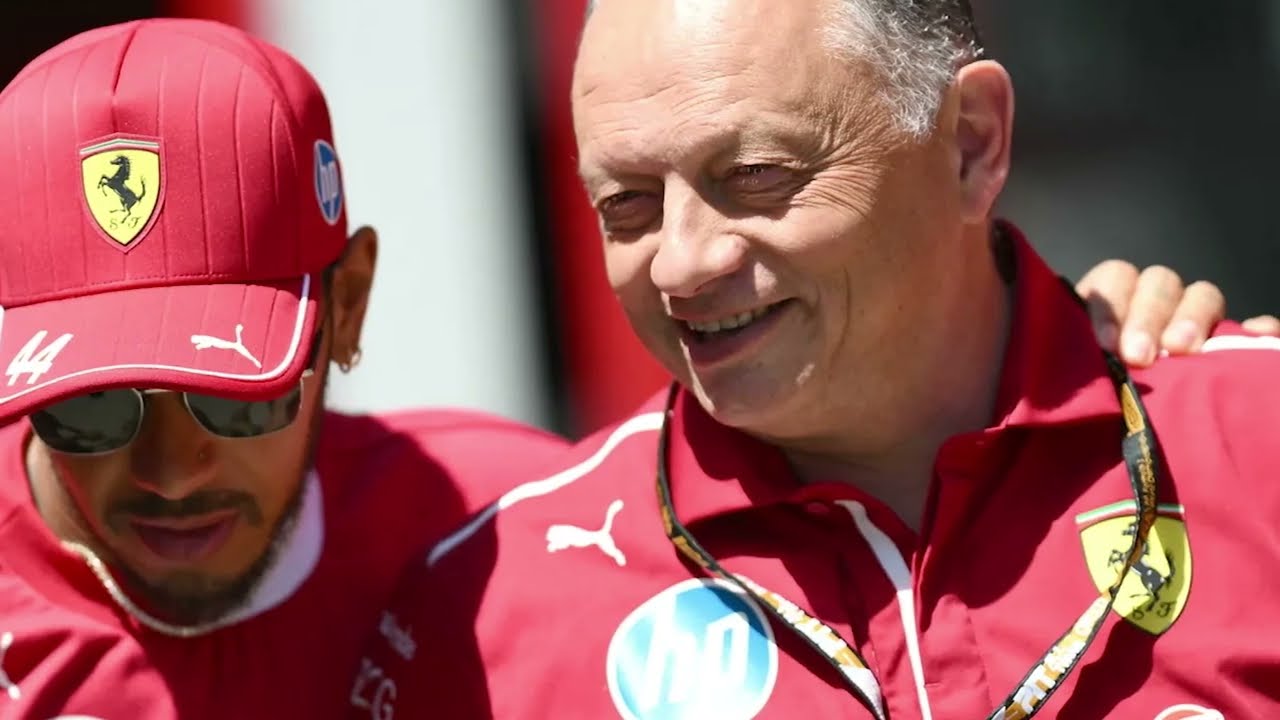
During pre-season testing in Bahrain, the SF-26 didn’t just look functional; it looked compliant. While the early paddock whispers continue to point toward Hamilton’s former home at Mercedes as the team to beat, there is a distinct sense of “paddock chess” being played at Ferrari. David Coulthard, the former Red Bull and McLaren ace, has been one of the first to suggest that the Scuderia is engaging in a classic distraction technique. In Coulthard’s view, Ferrari has deliberately dangled a radical rear wing concept in front of the world’s photographers, effectively baiting the media and rival engineers into obsessing over a visible detail while the true performance gains—the “real magic”—are buried deep within the underbody or hidden under the engine cover.
This theory of a “shiny distraction” is supported by the observations of veteran technical analyst Gary Anderson. While most teams have followed a predictable path with the new 2026 power unit regulations, Anderson noted a startling detail on the Ferrari: they appear to be running a significantly smaller turbocharger than their rivals. This is a bold, unconventional move. In a sport where power is king, opting for a smaller turbo suggests a focus on extreme packaging efficiency and sophisticated energy recovery. If Ferrari has mastered the trade-off between peak power and aerodynamic gains from a tighter engine cover, they may have found a loophole that the rest of the grid missed. The intrigue alone has ensured that every time the SF-26 leaves the garage, it is followed by a literal army of rival photographers, yet Ferrari Team Principal Frederic Vasseur remains unbothered.

Vasseur’s leadership has brought a new, aggressive philosophy to Maranello. He has openly encouraged his engineers to operate at the very edge of the regulations, noting that innovation only occurs when you are willing to explore the “grey areas” of the rulebook. However, Vasseur is also a pragmatist. He knows that in the era of the cost cap, an illegal innovation is a death sentence for a season’s budget. Ferrari has maintained a constant dialogue with the FIA to ensure their creative interpretations of the 2026 rules remain within the lines. “The most interesting ideas,” Vasseur recently teased, “are the ones you cannot see from the outside.” This statement has only added fuel to the fire that the visible parts of the SF-26 are merely the tip of an iceberg.
Beyond the technical wizardry, there is the human element. Hamilton’s first year at Ferrari in 2025 was a culture shock. Moving from the clinical, UK-based environment of Mercedes to the passionate, linguistically diverse, and often chaotic atmosphere of Maranello required a mental audit. Hamilton spoke candidly about the challenges of homesickness and the pressure of carrying the hopes of the Tifosi. He entered 2025 with the singular goal of winning the championship immediately, and when that didn’t happen, he had to look inward. He reached for a metaphor involving the “Year of the Fire Horse”—a symbol of freedom and the clearing of pressure. He realized that to win for Ferrari, he first had to rediscover the joy of racing.
That joy was on full display in Bahrain. When the covers came off the SF-26, Hamilton described the pressure melting away. This “childlike excitement” is perhaps more dangerous to his rivals than any rear wing concept. A happy Lewis Hamilton is a fast Lewis Hamilton, and a fast Lewis Hamilton in a Ferrari that he feels he has “helped shape” is a nightmare scenario for the rest of the grid. His teammate, Charles Leclerc, also shares this quiet confidence. The two drivers have been circulating the Sakhir circuit with a poise that suggests they aren’t searching for lap times, but rather verifying what they already know the car can do.
As the circus moves toward the season opener in Melbourne, the questions remain: Are Ferrari and Hamilton lying about their true pace? Is the SF-26 a revolution disguised as a work-in-progress? Reliability will be the final arbiter. Vasseur has emphasized that if the car stays in the garage, progress stops. In testing, the SF-26 ran like a clock, allowing the team to gather mountains of data while their rivals struggled with the complexities of the new hybrid systems. If the car is as reliable as it is innovative, the 2026 season might not be a battle of Mercedes vs. Red Bull, but rather a dominant return to form for the Prancing Horse.
For the fans, the prospect of Hamilton and Leclerc fighting at the front in Melbourne is the ultimate draw. But for the engineers at Mercedes and Red Bull, the sight of Hamilton’s smile is a cause for profound concern. They know that in Formula 1, when someone looks that happy during testing, they are usually hiding a very big, very fast secret. The chess pieces are set, the distractions are in place, and the true pace of the SF-26 is about to be unleashed on the world.