The Ghost in the Machine: How Max Verstappen’s Secret “Micro-Steering” Technique Is Rewriting the Rules of Formula 1 Performance
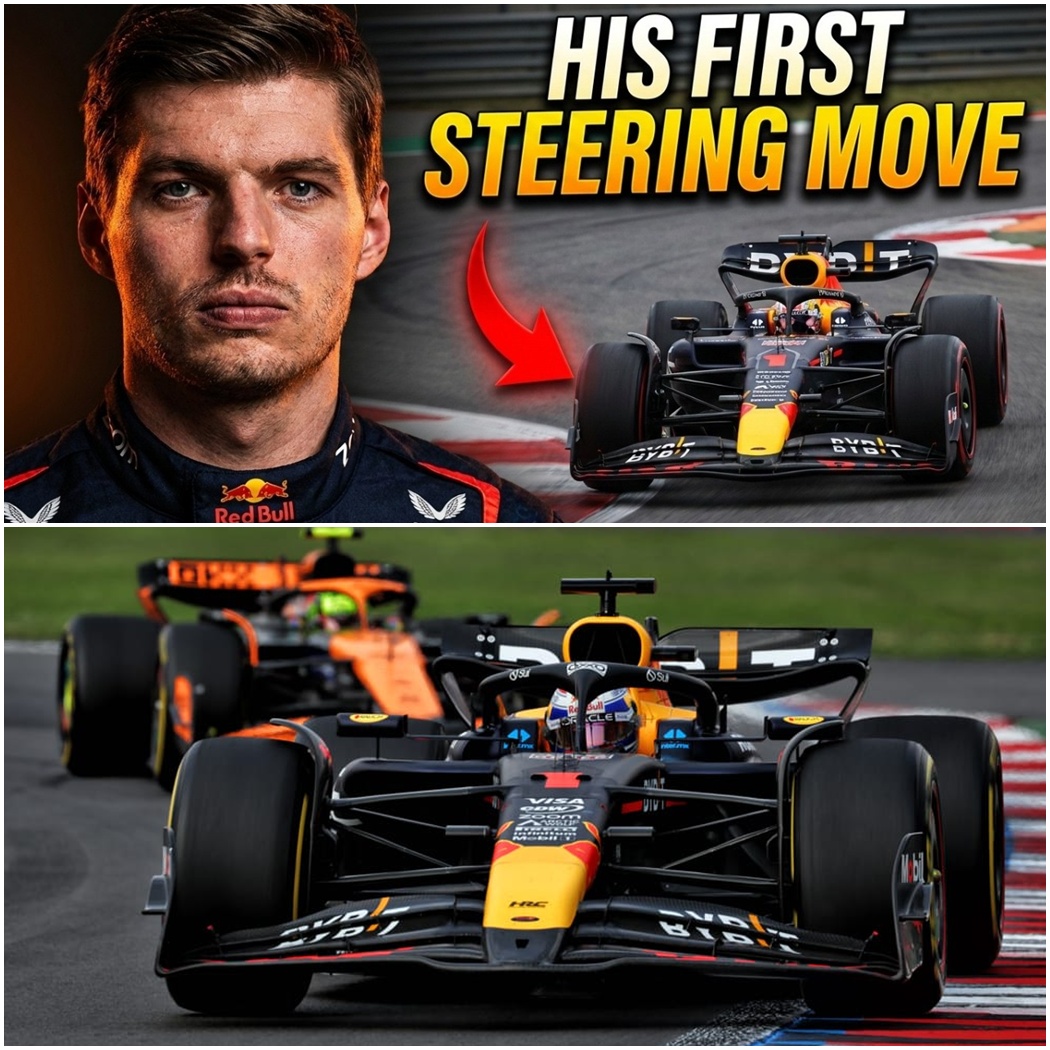
In the high-octane world of Formula 1, where races are won and lost in the thousandths of a second, the difference between a legend and a mere participant often lies in details invisible to the naked eye. We watch the cars scream past at 200 mph, we see the sparks fly under heavy braking, and we marvel at the lightning-fast pit stops. But deep within the cockpit, in the split-second transition between a straightaway and a corner, a quiet revolution is taking place. Recent telemetry analysis has pulled back the curtain on a technique so subtle, yet so devastatingly effective, that it is leaving the rest of the grid in a state of collective disbelief. This is the story of Max Verstappen’s “first steering input”—a tiny movement that is fundamentally changing how we understand the physics of racing.
To the casual observer, Max Verstappen’s driving looks smooth, almost effortless. When he approaches a corner like the high-speed sweeps of Albert Park or the technical hairpins of Suzuka, he appears to be doing exactly what every other world-class driver does: braking, turning, and accelerating. However, when engineers dive into the digital heartbeat of the car—the telemetry traces—they see a pattern that defies traditional racing logic. While most drivers approach a corner with a decisive, sharp turn of the wheel to set the car’s trajectory, Verstappen does something entirely different. He starts with a “micro-input”—a steering movement so small it looks like a hesitation. But in the world of elite motorsport, this isn’t doubt; it is the ultimate form of control.
The Physics of the First Input
To understand why this matters, we have to look at the violent forces acting on a Formula 1 car during corner entry. As a driver slams on the brakes, the weight of the car shifts dramatically forward. The front tires are crushed into the asphalt, bearing the brunt of the decelerating force. At this precise moment, the driver begins to turn. For most, the instinct is to commit. They turn the wheel to the required angle quickly to get the car rotating toward the apex. This method is effective, but it is also brutal. It demands that the front tires transition instantly from handling massive longitudinal braking forces to generating lateral cornering grip.
If this transition is too aggressive, the tires reach their “slip angle” too quickly. They become overloaded, lose their grip on the surface, and the car begins to “push” or understeer. The driver then has to make corrections, scrubbing off speed and killing the momentum. Verstappen’s genius lies in his refusal to overload the rubber. By starting with that tiny initial steering movement, he is essentially “asking” the tires how much grip they have before he “demands” it. This progressive loading allows the tire’s contact patch to settle and grip the road more effectively. It is the difference between slapping someone and a firm, increasing push; the latter allows for a more controlled transfer of energy.
The Two-Stage Telemetry Secret
When you overlay Verstappen’s steering telemetry with that of his rivals, the difference is startling. Most drivers show a steep, clean line as the steering angle rises. Verstappen’s trace often shows two distinct stages. First, there is that shallow, initial ramp—the micro-input. Then, a fraction of a second later, once the car has settled and the front tires have “bitten” into the track, he adds the second, larger steering angle.
This two-stage process allows the car to rotate more naturally. Because the initial turn is so small, it doesn’t upset the aerodynamic balance of the car. In modern F1, where the floor and wings are sensitive to every millimeter of change, keeping the platform stable is everything. By gently nudging the car into the turn, Max ensures that the airflow remains attached and efficient. The result is a car that rotates faster and more naturally around its vertical axis—a metric engineers call the “yaw rate.” Paradoxically, by turning the wheel less at the start, Max makes the car turn more at the apex.
Tire Management: The Hidden Advantage
The benefits of this technique extend far beyond a single lap’s speed. In the era of high-degradation tires, management is the key to winning championships. When a driver forces a car into a corner with an aggressive steering input, they create “tire scrub.” This is essentially the tire sliding sideways across the track surface, generating immense heat and wearing down the delicate rubber compounds.
Verstappen’s micro-input almost entirely eliminates this unnecessary scrub. Because the car is rotating naturally and the tires are being loaded progressively, they stay within their optimal temperature window for much longer. Over a 50-lap race distance, this means Max can push harder for longer while his rivals’ tires are “falling off a cliff.” This is why we often see Max pulling away in the final stages of a stint; he isn’t just faster, he is kinder to his equipment through a technical masterclass that starts the moment he enters a turn.
The Exit Connection: Where the Time is Found
Perhaps the most terrifying aspect of this technique for the rest of the field is how it sets up the exit of the corner. In racing, the “exit” is everything. The earlier you can get back on the power, the higher your top speed will be at the end of the following straight. Because Max’s car settles so quickly and rotates so efficiently at the entry, he is able to straighten the steering wheel much earlier than his competitors.
Telemetry shows that in certain medium-speed corners, Max is reaching full throttle significantly earlier than other drivers. While others are still fighting mid-corner instability or waiting for the front end to grip, Max has already completed his rotation and is launching down the straight. Those few tenths of a second gained at the exit of every corner add up to a dominant margin by the end of a 3.5-mile lap. It is a compounding interest of speed, built on the foundation of a steering input that most people don’t even notice.
The Human Element: Feeling the Invisible
The question that haunts every other team on the grid is: can this be taught? On the surface, the answer should be yes. Telemetry is a map, and any driver can see what Max is doing. But executing it is a different matter entirely. This technique requires a level of sensory feedback that only a handful of humans possess. To use a micro-input effectively, you have to be able to “feel” the microscopic changes in tire grip through the steering column and the seat of your pants. You have to be comfortable operating on the absolute knife-edge of physics, trusting that the tiny movement you just made will provide the information you need to commit to the rest of the corner.
Max Verstappen has often been described as a “video game driver” because of his precision, but this steering technique proves he is anything but robotic. It is a deeply organic, sensitive way of interacting with a machine. He isn’t just operating a car; he is in a constant, high-speed dialogue with it. While others are trying to dictate to the car what it should do, Max is listening to what the car can do, and then maximizing that potential.
As we look toward the future of the 2026 season and beyond, the “Verstappen Touch” remains the benchmark for the sport. It is a reminder that even in an age of supercomputers and advanced simulations, the ultimate performance still rests in the hands—and the fingers—of the driver. The tiny steering tweak that is currently terrifying the F1 grid isn’t a secret part or a clever engine map; it is the physical manifestation of a generational talent rewriting the rules of what is possible behind the wheel. For the rest of the drivers, the challenge is clear: find a way to match that level of sensitivity, or continue to watch the back of a Red Bull disappear into the distance.