The Day the Grid Melted: How Lance Stroll Defied the Skating Rink of Istanbul to Claim a Historic F1 Pole
The modern landscape of Formula One is an incredibly calculated, multi-billion-pound environment where unpredictability is viewed by engineers as the ultimate enemy. Teams spend countless hours running complex computer simulations, analyzing wind tunnel data, and refining aerodynamic footprints to ensure that when their multi-million-pound machinery hits the asphalt, performance is a guaranteed metric. It is a sport dictated by cold, clinical precision. However, every so often, the natural world collides with the clinical bubble of the paddock in such a violent, chaotic fashion that the established hierarchy is completely pulverized. When this happens, pure human drama, visceral emotion, and strategic bravery take center stage, leaving fans and commentators in a state of absolute awe. There is perhaps no greater modern example of this beautiful anarchy than the legendary qualifying session of the 2020 Turkish Grand Prix at Istanbul Park. It was a weekend that began in utter confusion, escalated into an absolute farcical thriller, and concluded with one of the most unexpected, shock pole positions in the entire history of global motorsport—a moment that firmly belonged to a young, heavily scrutinized Canadian driver named Lance Stroll.
To fully understand the magnitude of the shockwave that reverberated through the sport on that cold November afternoon, one must first transport themselves back to the bizarre and fragmented landscape of the 2020 Formula One World Championship season. The global pandemic had completely fractured the original racing calendar, forcing the sport’s governing bodies to abandon traditional venues and frantically seek refuge at classic, legendary circuits that had long fallen off the radar. Istanbul Park, a majestic facility designed by the legendary architect Hermann Tilke and famed for the ferocious, multi-apex Turn 8, had not hosted a Formula One race since 2011. Its sudden return to the calendar was met with massive excitement from drivers and fans alike, but absolutely nobody could have predicted the sheer technical nightmare that was waiting for the grid on the historic shores of the Bosporus.
The nightmare began not with the weather, but with the physical track surface itself. In a desperate, last-minute rush to prepare the venue for the pinnacle of motorsport, the circuit organizers had completely resurfaced the entire track just days before the teams arrived. To the untrained eye, the fresh, dark asphalt looked immaculate. To a Formula One tyre, however, it was an absolute death trap. The freshly laid bitumen was still actively weeping natural oils, creating an invisible, glossy sheen across the entire racing line. To compound this slick disaster, the autumn weather in Istanbul brought uncharacteristically freezing ambient temperatures. This meant the circuit was effectively a giant, open-air sheet of black ice.
Pirelli, operating on historical data from a decade prior, had anticipated high-energy lateral demands from Turn 8 and had conservatively brought their hardest, most durable tyre compounds—the C1, C2, and C3. These specific tyres require massive, sustained kinetic energy and high track temperatures to properly switch on and generate mechanical grip. On a freezing, oil-slicked track, generating that vital tyre temperature was an absolute physical impossibility. During Friday’s initial practice sessions, drivers were spinning out in straight lines while travelling at mere fraction of their top speeds, looking like helpless passengers in their own highly engineered vehicles. The legendary six-time world champion Lewis Hamilton was left utterly bewildered by the total lack of traction, candidly describing the surface as “pretty terrible” and famously stating to the media that there “ain’t no grip” out there. It was a humiliating equalizer that brought the entire grid to its knees, and the situation was about to become significantly worse.
On Saturday morning, a massive, relentless torrential downpour arrived over Istanbul Park, completely soaking the oily, freezing tarmac. The track surface transformed instantly into a treacherous skating rink, where the boundary between a brilliant lap and a catastrophic accident was measured in millimetres. Yet, in the absolute midst of this aquatic anarchy, one driver appeared to operate on a completely different physical plane: Red Bull Racing’s young prodigy, Max Verstappen. While twenty of the best drivers on Earth were sliding helplessly into the run-off zones, looking completely toothless against the elements, Verstappen was putting on an absolute wet-weather clinic. He masterfully danced his Red Bull RB16 on the absolute precipice of disaster, catching violent snaps of oversteer with supernatural reaction times. He topped Free Practice 3, and as the chaotic qualifying session commenced, his superiority was downright insulting to the rest of the field. In both Q1 and Q2, Verstappen was consistently topping the timing monitors by massive gaps, sometimes separating himself from his own highly capable teammate, Alexander Albon, by well over two full seconds. He looked completely and utterly bulletproof, an absolute certainty for pole position as the top-ten Q3 shootout loomed.
The qualifying session itself was heavily disrupted, punctuated by lengthy red flags as the severe rain intensified, turning sections of the track into active rivers. The struggle to get the green-walled intermediate tyres or the blue-walled full wet tyres to generate even a single degree of vital temperature completely destroyed the prospects of the sport’s traditional heavyweights. The mighty Mercedes AMG Petronas team, usually so relentlessly dominant in the turbo-hybrid era, looked entirely lost in the fog, unable to find any semblance of grip. The Scuderia Ferrari and McLaren teams fared even worse, with both legendary outfits failing to even progress into the top-ten shootout, stranded a staggering five seconds off the leading pace. Instead, unlikely heroes emerged from the spray. The Alfa Romeo squad, beautifully powered by the immense wet-weather experience of veteran Kimi Räikkönen and Antonio Giovinazzi, found an incredible sweet spot in the treacherous conditions, comfortably sailing into Q3 while the old guard drowned.

As the final ten minutes of Q3 commenced, the heavy rain finally began to ease slightly, and a very faint, marginally less wet racing line began to emerge through the standing water, although the track surface remained profoundly wet. It was at this exact, high-stakes juncture that the Racing Point team, running the highly controversial RP20—affectionately and mockingly dubbed the “Pink Mercedes” due to its striking design similarities to the previous year’s championship-winning car—recognized a fleeting, golden window of commercial and sporting opportunity. While the vast majority of the grid, including a confident Verstappen, automatically bolted on a fresh set of full wet tyres, Racing Point chose to execute a highly aggressive strategy gamble. They boldly sent Sergio Perez and Lance Stroll out into the spray on the green-walled intermediate tyres.
Initially, the gamble looked like a catastrophic operational error, as Alpine’s Esteban Ocon struggled immensely to switch the intermediate compound on. But the moment the experienced Sergio Perez crossed the timing beam, he completely shattered the weekend’s baseline, going quickest of all by a country mile and lighting up the timing screens in purple. Red Bull, watching the monitors in absolute shock from the pit wall, immediately aborted Verstappen’s flying lap on full wets and dragged him into the garage to emulate Racing Point’s tyre choice. However, their timing proved to be sub-optimal. Verstappen emerged from the pit lane into a dense pocket of traffic, finding himself tucked closely behind Kimi Räikkönen’s Alfa Romeo. In the freezing spray, unable to back off without completely missing his final attempt before the checkered flag, Verstappen was forced to follow the veteran Finn, heavily destroying his delicate tyre temperatures in the process. He suffered a violent, heart-stopping snap of oversteer at Turn 7, costing him six-tenths of a second—a mistake that would prove to be fatal to his pole position ambitions.
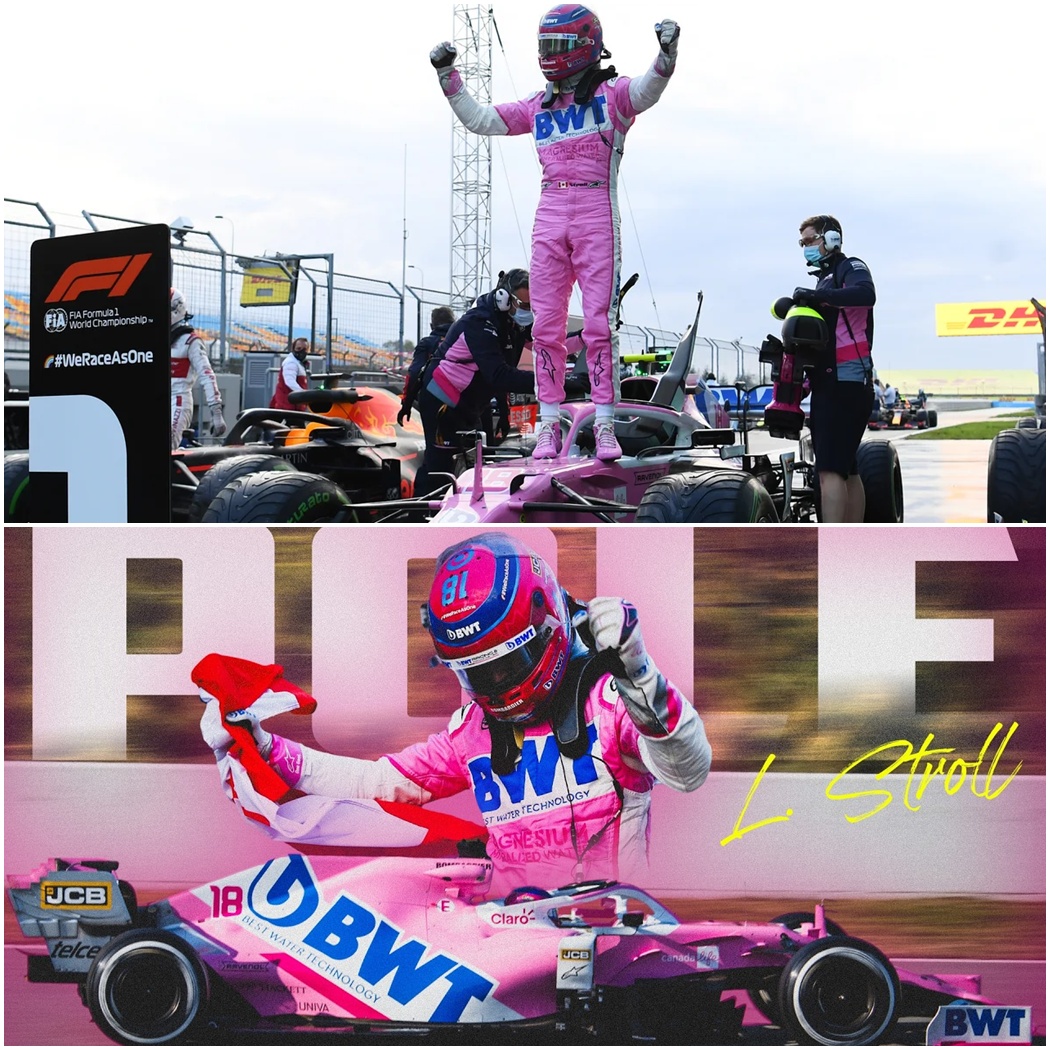
Meanwhile, entirely away from the traffic, Lance Stroll was putting together the definitive, history-making performance of his entire life. The young Canadian had been enduring a brutal, deeply demoralizing run of form heading into the Turkish weekend, suffering from a heavy crash at Mugello, mid-season illnesses, and intense, relentless public scrutiny regarding his place in the sport as the son of a billionaire team owner. The pressure resting on his young shoulders was immense. Yet, when it mattered most, Stroll kept his focus entirely absolute. He perfectly pinned all three treacherous sectors together, finding an unbelievable amount of traction where others found none, and crossed the line to record a blistering time of 1:47.765.
When the timing screens updated to show Lance Stroll had snatched pole position by nearly three-tenths of a second from a furious, expletive-spewing Max Verstappen, the collective paddock was left completely stunned. The radio communication that immediately followed was a beautiful, raw release of pure human emotion—a full-throated roar of absolute relief from a young man who had been thoroughly battered by critics for months. With that single, magnificent lap, Stroll became the first Canadian driver to secure a Formula One pole position since the legendary Jacques Villeneuve achieved the iconic feat at the 1997 European Grand Prix in Jerez. It was a monumental, historic milestone for the Silverstone-based squad, marking their first-ever pole under the Racing Point banner, just four races before their high-profile transition into Aston Martin.

While the history books will forever celebrate Stroll’s magnificent Saturday triumph, Sunday’s race would unfortunately serve as a brutal, heartbreaking reminder of the deeply unforgiving nature of top-tier motorsport. Off the starting line in the wet, Stroll was absolutely imperious, launching beautifully to fend off the Red Bulls and opening up a commanding, comfortable ten-second lead over his teammate Perez. He looked fully in control of his destiny, on track for a fairytale maiden victory. However, as the track slowly began to transition and a second set of intermediate tyres was fitted during the mandatory pit stops, his brilliant pace suddenly vanished into thin air. He plummeted down the order, struggling heavily with tire graining, eventually crossing the line in a distant, disappointing ninth place, completely dumbfounded by his lack of speed.
It was only after the race, during the team’s routine post-race car teardown back in the garage, that a tragic technical truth was finally discovered. A small aerodynamic strake on the underside of Stroll’s front wing had come loose during the race and lodged itself in such a malicious way that the resulting blockage caused a massive, significant loss of vital front downforce. This hidden imbalance was the direct contributor to the catastrophic tyre graining that ruined his stints. While his experienced teammate Perez went on to secure a brilliant P2, and Lewis Hamilton drove a legendary tactical masterclass to win the race and secure his historic seventh World Championship, a confused and frustrated Stroll was left to contemplate what might have been.
The 2020 Turkish Grand Prix qualifying session remains forever etched in motorsport folklore as a definitive testament to the beautiful, untamed unpredictability of Formula One. It emphatically proved that when the clinical, engineering-dominated predictability of the sport is completely stripped away by the raw elements of nature, human talent, strategic bravery, and absolute drama will always rise to the top. Lance Stroll’s spectacular, ice-cool skating lap to pole position will forever stand as one of the most shocking, thrilling, and emotionally charged moments of the modern racing era—a perfect reminder of why we fall in love with this sport.








