The Collapse of Aston Martin’s Masterplan: Why Fernando Alonso Faces a Heartbreaking Early Retirement
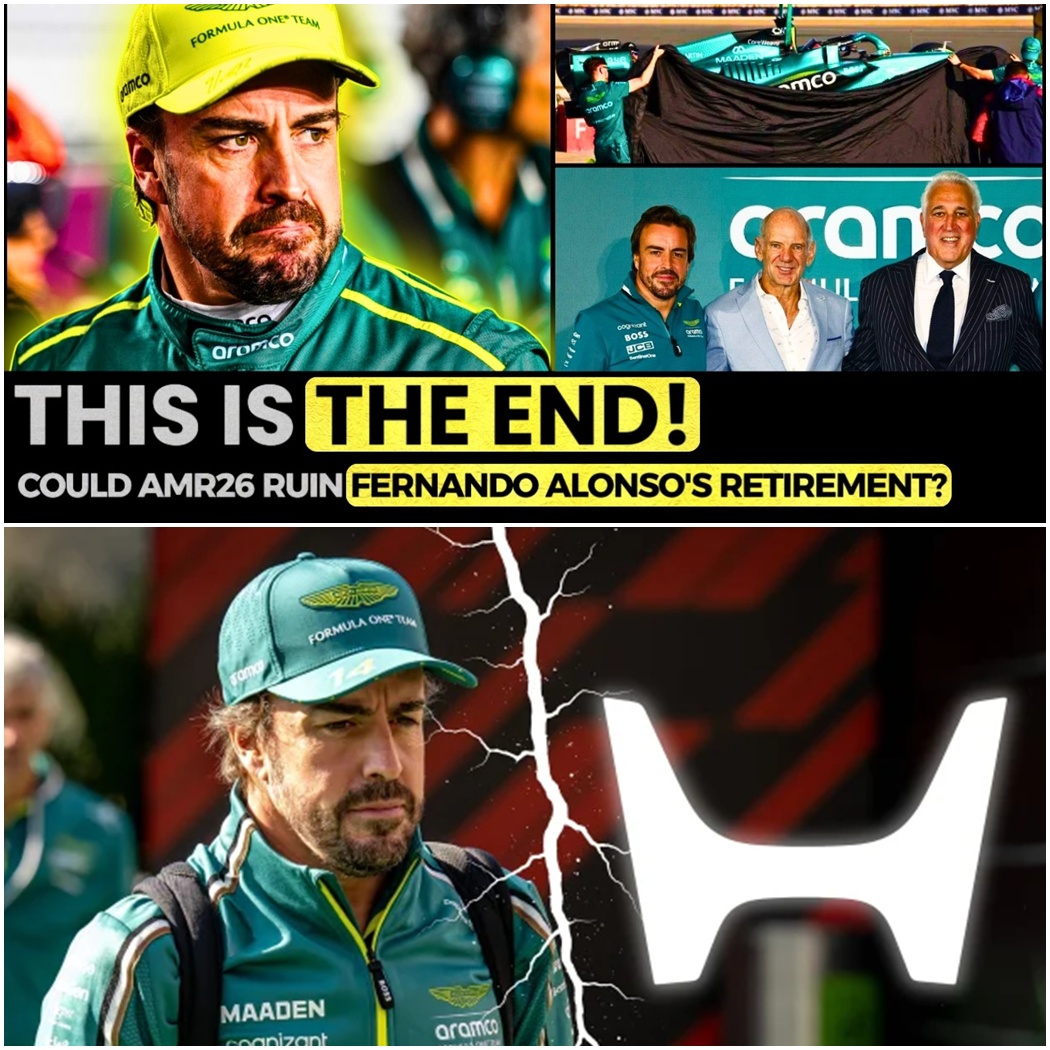
Something fundamentally vital is breaking inside the walls of Aston Martin, and it appears to be dragging the final, glittering chapter of Fernando Alonso’s Formula 1 career down with it . The dawn of the 2026 Formula 1 season was universally heralded as the ultimate reset, a blank canvas where ambitious teams could rewrite the competitive hierarchy. For Aston Martin, this was supposed to be the spectacular rebirth of a legend. The team had aggressively positioned itself as the grid’s next dominant superpower. With the monumental arrival of aerodynamic genius Adrian Newey, staggering financial investments behind the scenes, a state-of-the-art technology campus in Silverstone, and the highly anticipated integration of a works Honda power unit, 2026 was explicitly designed to be the year Aston Martin decisively attacked the front of the grid.
Instead of stepping into the ring as heavyweights, they are staring into the abyss, hopelessly marooned at the bottom of the timesheets following a spectacularly disastrous preseason testing period in Bahrain. But the tension echoing through the paddock is not merely about sluggish lap times or missed aerodynamic targets; it is about the one inescapable, unrelenting force that no engineer can outsmart: time itself. Fernando Alonso turns 45 years old this summer . For a driver in the twilight of an extraordinary career, every failed development run, every lost kilometer on the track, and every mechanical failure cuts infinitely deeper than it ever did before.
The raw data emerging from the Bahrain international circuit paints a brutal and unforgiving picture. While direct rivals like Mercedes, Red Bull, Ferrari, and McLaren seamlessly executed aggressive long runs, race simulations, and complex aerodynamic mapping programs, Aston Martin languished in the garage. Across six grueling days of critical track time, the team managed to complete a meager 334 laps . In the unforgiving ecosystem of modern Formula 1, that is not an environment of preparation or refinement; it is absolute survival mode. The AMR26, the highly publicized machine designed under the overarching technical direction of Adrian Newey, was widely expected to signal a profound philosophical reset for the team. Instead, it brutally exposed deep-rooted structural weaknesses that insiders claim were actually detected several months ago .
According to concerning reports leaking from the Spanish press, notably the outlet Marca, the internal alarm bells at Silverstone began ringing deafeningly loud well before the cars even arrived in the Middle East for testing . The reports suggest that the engineering team realized three to four months prior that something fundamental was critically misaligned. The central crux of the crisis appears to revolve around the power unit integration with their new partners, Honda. When blending a brand-new engine architecture with highly complex aerodynamic concepts, the margins for error are microscopic. Aston Martin is reportedly suffering from catastrophic cooling architecture limitations, severe packaging compromises, and terrifying correlation issues between their factory simulations and real-world track data .
In modern Formula 1, correlation is the absolute bedrock of success. If a team’s wind tunnel and supercomputers tell them a part will generate a specific amount of downforce, and it spectacularly fails to do so on the actual tarmac, the entire developmental roadmap collapses. It is not merely a small glitch; it is a fundamental, structural miscalculation that blinds the engineering team. Furthermore, if the aerodynamic platform of a car is compromised by the necessity to open up cooling vents or alter the internal layout to accommodate engine inefficiencies, overall performance degrades exponentially . Fixing a foundation this deeply flawed won’t be a simple cosmetic tweak or a minor front-wing adjustment. It will require massive strategic sacrifices, complete component redesigns, and months of lost time—a reality that Fernando Alonso understands intimately.
This presents a deeply uncomfortable question: is this merely a technical misstep, or a sign of deeper organizational fractures beginning to show under the immense weight of expectation? Publicly, the narrative is fiercely protected. Alonso, ever the astute politician and seasoned veteran, insists that there are solutions on the horizon . He speaks calmly to the media, discussing planned adjustments before the season opener in Australia and expressing confidence in correcting weaknesses during the opening rounds. This calculated optimism is a masterclass in leadership; Alonso knows that a publicly destabilized, openly critical driver only accelerates a team’s internal crisis .
However, privately, the reality is brutally complex. Early-season recovery under a completely new set of technical regulations is practically impossible without sacrificing long-term goals. When a car is fundamentally off in its mechanical balance, aerodynamic mapping, and power unit integration, updates are not simply “plug and play.” They require extensive redesign phases, long manufacturing lead times, and rigorous validation processes . While Aston Martin spends the crucial first five races desperately trying to repair structural flaws, their rivals are already refining, evolving, and pulling further away.
This brings us to the silent, suffocating pressure of expectation management. Aston Martin did not market 2026 as a transition year or a rebuilding phase . When an organization secures the legendary Adrian Newey and successfully courts a powerhouse like Honda, they are explicitly promising a title-contending era. When you promise acceleration and deliver stagnation, confidence within the organization, the boardroom, and the cockpit erodes rapidly. The AMR26 does not just lack raw pace; it appears conceptually misaligned with the entire competitive direction of the grid.
For Fernando Alonso, the stakes transcend a single disappointing season; this is about legacy preservation . His last championship titles were secured two decades ago in 2005 and 2006. His last race victory was over a decade ago in 2013 . His career has been defined by his superhuman ability to extract impossible results from mediocre machinery, enduring years of strategic gambles, rebuilding projects, and agonizing near-misses. Aston Martin was supposed to be the exception. It was designed to be the perfectly timed, final strike under the new regulation era to cap off one of the greatest careers in motorsport history. Instead, he finds himself driving an AMR26 that is struggling to even simulate midfield consistency .
Insiders within the paddock whisper that if the car cannot consistently fight within the top five before the mid-season break, retirement becomes not just an emotional possibility, but a deeply logical inevitability . This isn’t a matter of Alonso’s fiery passion fading; it is the cold, hard competitive reality tightening its grip around him. At 45 years old, he no longer possesses the luxury of waiting out another three-year developmental cycle. If Aston Martin cannot urgently transform this crisis into competitiveness, Alonso’s options rapidly expand beyond the Formula 1 paddock .
The conversation surrounding his future has already shifted toward alternative racing categories where his immense talent can still secure major victories. Paddock discussions frequently speculate about a return to the IndyCar Series to chase the elusive Triple Crown, further campaigns in the World Endurance Championship, or even another grueling attempt at the Dakar Rally . Alonso has unequivocally proven that he can compete—and dominate—at an elite level outside of Formula 1. Extending his Formula 1 career into 2027 would demand one strict, non-negotiable condition: the Aston Martin must genuinely fight for pole positions and race victories against the established elite, not merely scrape for occasional points .
The ticking clock is deafening, and the next few races will not just define Aston Martin’s season; they could very well define the closing chapter of a sporting legend . The AMR26 desperately needs to show proof of life. It needs to prove that its underlying philosophy can work, that the Honda integration can be stabilized, and that this grand project is genuinely worthy of one more year of Alonso’s illustrious career . If the Australian Grand Prix and the subsequent opening rounds expose the exact same structural weaknesses witnessed in Bahrain, the decision to walk away will no longer be an emotional agonizing process—it will be inevitable. The world is watching, and for Fernando Alonso, the final audition has officially begun.








