The Silver Shockwave: Max Verstappen Conquers the Green Hell and Leaves Formula 1 Holding Its Breath
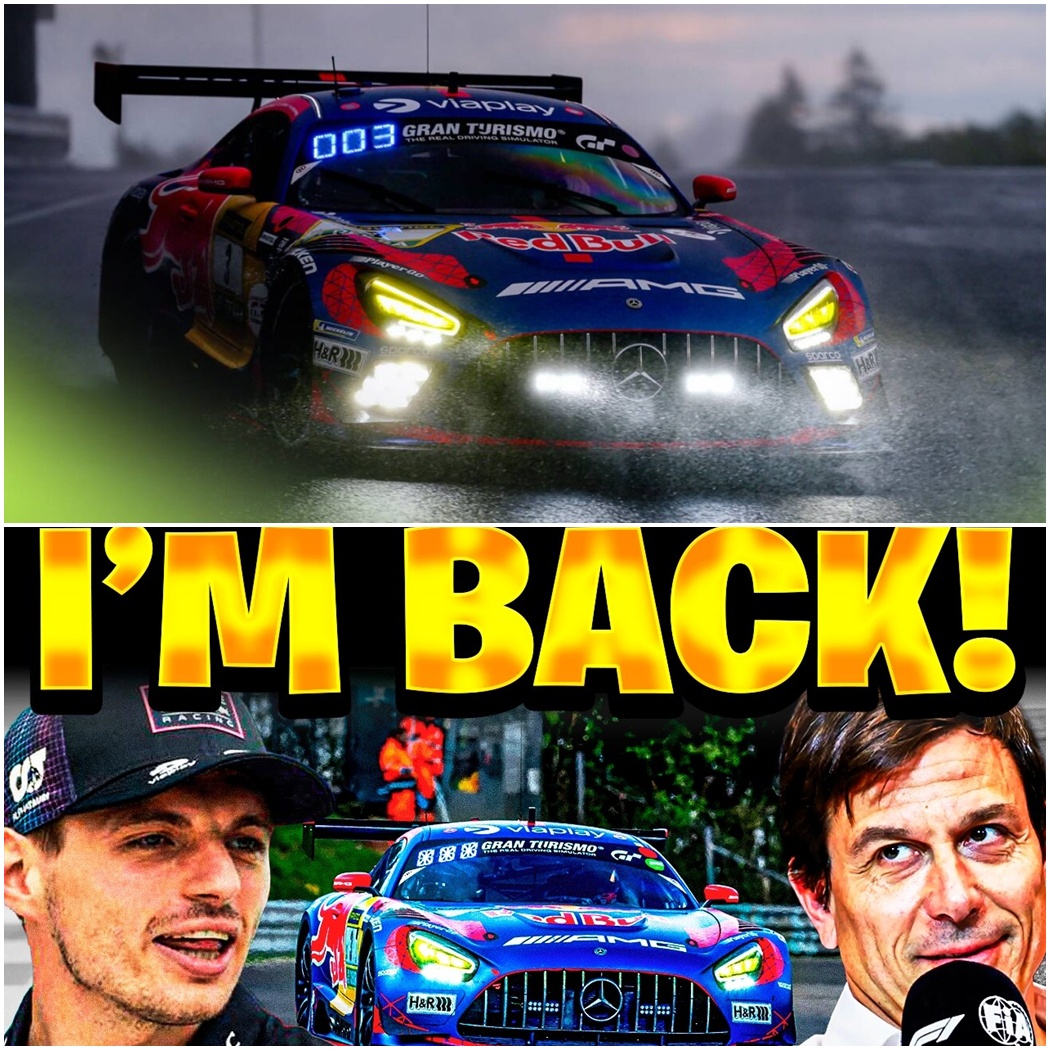
Max Verstappen has just executed a performance that should send a very cold, very real shiver down the collective spine of the Formula 1 paddock. In the freezing, unforgiving environment of the Nurburgring Nordschleife, amidst chaotic weather that saw hail relentlessly battering the tarmac and cars bursting into flames, the reigning world champion did something extraordinary. He climbed into a heavy Mercedes GT3 machine for his very first official track day at the legendary circuit and immediately decimated expectations. Against a fiercely competitive grid of elite endurance racing specialists—veterans who have dedicated their entire careers to mastering the nuances of this terrifying track—Verstappen calmly secured the third-fastest overall time. But it is not just the impressive stopwatch that has the motorsport world reeling; it is the highly politicised context of his achievement. Because watching intently from the Mercedes garage, having flown in specifically for the occasion, was Toto Wolff. Suddenly, a seemingly innocent extracurricular racing weekend has transformed into a massive, heavily scrutinised statement of intent.
To truly grasp the magnitude of what Verstappen achieved, one must understand the sheer brutality of the arena. The Nurburgring Nordschleife, affectionately and fearfully known as the Green Hell, is not a normal racing circuit. It is a terrifying, sprawling twenty-five-kilometre ribbon of asphalt violently carved through the dense Eifel forest. It does not forgive; it actively punishes. Drivers are forced to memorise an endless sequence of blind crests, terrifying elevation changes, off-camber corners, and brutal kerbs. One tiny miscalculation here does not simply result in a compromised lap time; it usually ends in a catastrophic impact with the unforgiving barriers. The conditions during this specific qualifying session were nothing short of apocalyptic. Temperatures plummeted to a freezing eight degrees Celsius. The circuit was a treacherous patchwork of wet and dry zones. Rain rapidly turned into sleet and hail, completely destroying any semblance of predictable grip.
Imagine, for a moment, the sheer terror of sprinting across a frozen, black-ice covered parking lot in the pitch dark, where random sections suddenly become frictionless without any prior warning. That is effectively what the drivers were dealing with. The session instantly devolved into pure survival mode. A Porsche aggressively caught fire in the demanding Schumacher S section of the circuit, and moments later, another Porsche slammed violently into the ensuing chaos. Yellow flags waved frantically across multiple sectors. Slow zones constantly interrupted any attempt at a clean rhythm. Most seasoned endurance drivers—men and women who intimately know every bump and surface change of this track—were understandably driving with extreme caution, simply trying to keep their machinery out of the walls.
And then, there was Max Verstappen. While the rest of the highly experienced grid reacted with entirely justified trepidation, the Dutchman looked almost supernaturally calm. In fact, he was the very first driver from his designated team to head out onto the perilous track. That specific decision speaks absolute volumes about his current psychological state. Most drivers inherently want to wait. They want to let others test the treacherous waters, clear the standing water, and provide crucial radio feedback regarding the grip levels. Verstappen desired absolutely none of that safety net. He wanted to confront the Green Hell immediately, entirely on his own terms. He did not travel to Germany simply to gain a little bit of casual experience or to enjoy a fun weekend away from his Formula 1 duties. He arrived with the explicit, ruthless intention to compete at the absolute highest level.
Initially, his lap times looked measured and controlled as he found his bearings in the heavy GT3 machinery. Then, the dynamic suddenly and violently shifted. After completing a mandatory installation run, Verstappen unleashed a blistering eight-minute and eighteen-second lap around the Nordschleife. That phenomenal, unexpected time instantly launched the Mercedes near the very top of the absolute standings, securing third place overall. The endurance racing establishment was left entirely stunned. These GT specialists spend years, sometimes decades, trying to truly unlock the secrets of the Nurburgring. They meticulously study the subtle shifts in tarmac friction and the exact aerodynamic balance required to survive the terrifying Flugplatz jump. Yet, Verstappen arrived and immediately looked genuinely competitive against drivers who have dedicated their lives to this specific discipline.
The transition from a modern Formula 1 car to a GT3 endurance racer is immensely difficult and historically problematic for many elite drivers. Formula 1 cars are lightweight, aerodynamically dependent fighter jets that change direction with violent immediacy. GT3 cars, by stark contrast, are heavyweight street machines. They are significantly heavier, they inherently slide far more, and they react much slower to steering inputs. A driver is forced to constantly fight and manage immense weight transfer and unpredictable tyre behaviour over massive bumps and heavily changing grip levels. To effectively switch from the pinnacle of open-wheel racing to a heavy GT3 car, especially in the middle of a freezing storm, requires an incredibly rare level of natural mechanical sympathy. Most Grand Prix drivers would struggle badly with that complex transition, fighting their own deeply ingrained muscle memory. Verstappen, however, adapted almost instantaneously, bending the heavy Mercedes to his absolute will.
That astonishing adaptation is exactly when the underlying atmosphere around the Nurburgring started changing completely. The paddock whispers grew louder. This no longer felt like a fun, lighthearted side project for a bored world champion. This started feeling incredibly serious. The intensity multiplied exponentially once concrete reports emerged that Mercedes Formula 1 Team Principal Toto Wolff had flown directly to the Nurburgring. Wolff was not there to oversee a Grand Prix weekend; he was there explicitly to watch Verstappen drive a Mercedes in person. At that exact moment, the entire narrative shifted drastically. The story became vastly bigger than the Nurburgring 24 Hours. It became a very public, highly visible chess move in the ongoing Formula 1 driver market war.
One can only imagine the deep, uncomfortable anxiety currently spreading through the Red Bull Racing headquarters in Milton Keynes. Every single lap that Verstappen confidently completed inside that Mercedes GT3 car actively created an image that Formula 1 fans and rival executives never truly expected to see look so remarkably natural. Here was their generational talent, their franchise driver, succeeding wildly in a silver machine bearing the iconic three-pointed star. He was not struggling to adapt; he was not looking for excuses. He was succeeding immediately and looking completely at home. The truly terrifying part for Red Bull is that the Nurburgring is arguably one of the worst possible places on the planet to fake pure performance. This specific circuit exposes a driver’s true nature brutally and instantly. You absolutely cannot hide behind clever pitwall strategy here. You cannot hide behind tyre management tricks or the benefit of running in clean air. The Green Hell violently forces drivers to reveal exactly how naturally gifted and brave they truly are.
As the session progressed and the conditions somehow managed to deteriorate even further, Verstappen’s underlying calmness became his most potent weapon. Rain heavily intensified, and hail relentlessly battered the circuit. Several highly experienced drivers sensibly chose to stop pushing entirely, accurately calculating that the risk of destroying the car had simply become too high. Racing through dense, dark forests where visibility violently changes every few corners is mentally exhausting. Grip disappears without any warning. Yet, Verstappen kept pounding round, emotionally untouched by the mounting pressure and the chaotic environment. That serene calmness actually matters significantly more than the impressive lap time itself. Endurance racing is fundamentally an exercise in deep psychological survival. Drivers must perfectly manage slower traffic, terrifying weather, deep fatigue, and immense internal pressure for hours on end.
Toto Wolff’s highly visible presence at the circuit suddenly made perfect, calculating sense. The Mercedes boss did not fly to a freezing forest in Germany simply to admire lap times on a timing screen. He was observing something far deeper and far more valuable. He was carefully watching Verstappen’s pressure management, his rapid technical adaptation, his unyielding speed, his communication with a new set of engineers, and his overarching mental control. Perhaps most importantly, Wolff was actively looking for genuine hunger. After years of utterly dominating Formula 1 and breaking nearly every conceivable record, does Verstappen still possess that raw, primal desire to push himself into the dangerous unknown? The answer, unequivocally displayed on the freezing German tarmac, was a resounding yes.
What the Nurburgring is currently revealing about Max Verstappen is profoundly fascinating. He does not look like a highly paid Formula 1 driver casually visiting another racing category for a weekend of fun. He looks entirely like a man who has just discovered a consuming new obsession. The entire endurance paddock can actively feel the shift in gravity. The Green Hell fundamentally exposes human traits that modern, highly sanitised Formula 1 circuits often hide: immense patience, raw instinct, and iron discipline. The track punishes oversized egos immediately; drivers who arrogantly push too hard usually become victims of the unforgiving barriers within minutes. Somehow, Verstappen navigates this terrifying tightrope flawlessly, looking entirely emotionally detached from the absolute frenzy swirling around him.
And the frenzy is indeed massive. Passionate motorsport fans flooded the viewing areas, desperately trying to catch a fleeting glimpse of the Mercedes number three car tearing through the forest. Reports from the ground even claimed that the official race organisers were forced to introduce special, unprecedented crowd control measures simply because the overwhelming ‘Verstappen effect’ became incredibly difficult to safely manage around certain parts of the circuit. Think about how fundamentally insane that reality truly is. This is not a glamourous Formula 1 Grand Prix weekend. This is a gritty, gruelling endurance race. Yet, one single driver has instantly become the undisputed, gravitational centre of the entire global event.
That astonishing level of presence fundamentally changes everything around a racing paddock. Competing teams notice it. Massive automotive manufacturers notice it. Global sponsors definitely notice it. And most importantly, Mercedes notices it. Every single television camera following Verstappen around the Nurburgring actively creates another highly uncomfortable, deeply symbolic image for Red Bull management. Max Verstappen looking completely natural, relaxed, and devastatingly fast in a Mercedes environment. There is absolutely no visible tension, no frustrating adaptation struggles, and no public complaints. There is only pure, unadulterated performance.
This is precisely why Toto Wolff’s strategic appearance feels so incredibly heavy with implications. The Formula 1 paddock is a village that constantly watches body language. Executives monitor exactly how drivers interact with their mechanics, how genuinely relaxed they look inside unfamiliar garages, and how naturally they integrate into fundamentally different corporate cultures. Verstappen already looks strangely, almost disturbingly comfortable in this new environment. It creates very dangerous, looming questions for the future. With Verstappen’s long-term commitment beyond 2026 remaining one of the most fiercely debated and heavily speculated topics in modern motorsport, weekends like this absolutely amplify the noise to a deafening volume.
The most compelling aspect of this unfolding drama is that the Nurburgring is refusing to give the world champion an easy, comfortable introduction. It is testing him with brutal severity. Freezing temperatures, completely mixed grip levels, torrential rain, heavy hail, terrifying crashes, and the daunting prospect of night driving. This is undeniably the hardest possible way to learn the intricate art of endurance racing. Yet, Verstappen keeps responding with the calm authority of a seasoned veteran who has spent decades racing in the Eifel mountains. Rival teams are growing visibly uncomfortable because normal drivers genuinely need considerable time to become a threat here. They must painstakingly learn how to manage slower traffic, find visual references in the pitch dark, establish a unique tyre rhythm, and master mental pacing. Verstappen already looks terrifyingly ahead of schedule.
Now, the entire motorsport world collectively holds its breath as everything builds toward the ultimate crucible: Top Qualifying. This is the moment of truth. One single, solitary flying lap. One chance to conquer the Green Hell. One tiny, fractional mistake away from absolute disaster, or one perfect, sweeping lap away from creating one of the most iconic, legendary Nurburgring qualifying performances in recent memory. The underlying pressure could not possibly be any greater. Because if Max Verstappen manages to miraculously take pole position in a Mercedes GT3 car at the Nurburgring, with Toto Wolff proudly watching from the back of the garage, this narrative explodes far beyond the realm of endurance racing. At that defining point, it entirely stops being a cool, off-season side project. It becomes a massive, undeniable statement of supreme talent, a terrifying warning to the rest of the motorsport world, and perhaps, a highly vivid preview of a Formula 1 future that the rest of the grid is simply not ready for yet. Every single lap he drives right now feels incredibly, historically important.








